This article is composed from parts of French
documents; the translation may contain inaccuraceies.
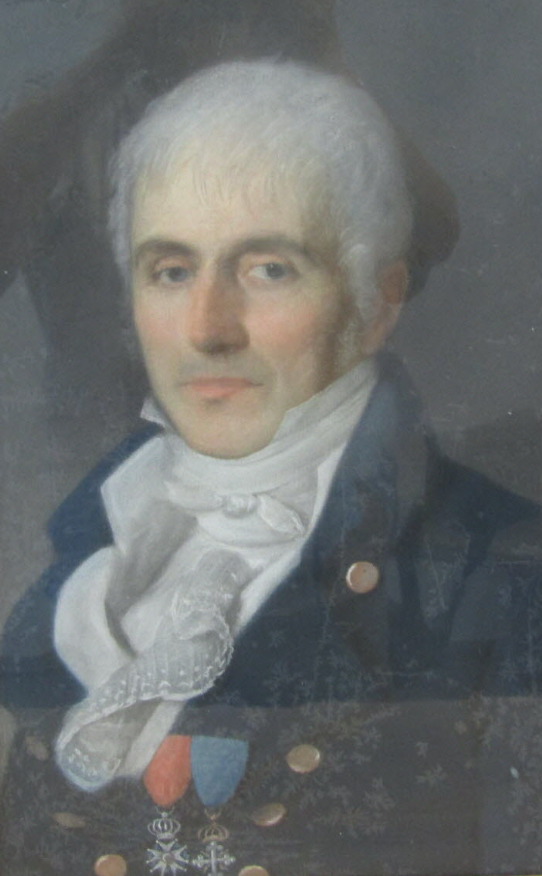
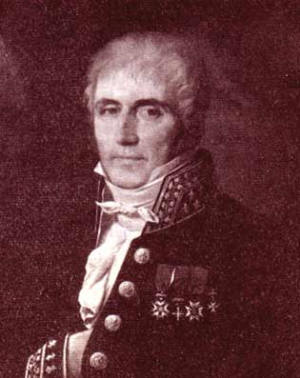
Louis Archambaud Douglas was born on 16 March 1758 in Montréal, in the Bugey region (department of Ain), France. He was the eldest son of Francois-Prosper Douglas and Charlotte de La Corne.
He received an education described as “both solid and brilliant,” from which he was expected to benefit throughout his life.
In 1788, on the death of his uncle Charles Joseph, Louis‑Archambaud succeeded to the County of Montréal. He immediately began extensive renovations to the ancestral home, and the Revolution of 1789 found him in the midst of a major building project. Moderate by temperament, and now the provisional lord of Montréal, he worked to prevent any pretext for violence in the community.
He was appointed Commander of the National Guard of the town, a position he still held at the Feast of the Federation on 14 July 1790. That September, he presented a flag to the Municipality.
The abolition of privileges on 4 August 1789 and the suppression of peerages on 17 June 1790 affected him only slightly.
He married shortly afterwards.
Although he was protected within his own community by the esteem and affection of his neighbours, the former Count Douglas was in grave danger whenever he left it. On 13 June 1793, his name appeared on a list of “suspect persons” who had left the District of Nantua for Lyon: “Duglas, noble lord and formerly of Montréal, his wife and child.”
Louis‑Archambaud Douglas also had a personal enemy in Nantua: his relative Joseph‑Bernard de Delilia Crose, a lawyer, member of the Third Estate, and native of Montréal. The quarrel between the two families was longstanding, despite occasional intermarriage. The Delilia family resented the Douglases as “newcomers” to the region—arriving in 1619—while they themselves claimed a presence of three centuries.
On 26 October 1793, “Citizen Douglas” travelled to Nantua on business and to have his residence certificate validated. The Oversight Committee immediately arrested him, but the same day the General Council of Montréal intervened forcefully on his behalf and secured his release.
Douglas was required to make further gestures of loyalty. On 28 October he surrendered more than fifty feudal documents to the commune to be burned, in accordance with the law of 17 July 1793.
At the same time, he was troubled by rumours concerning Canada, and on 6 November he was obliged to present a detailed account of the circumstances of his birth to prove that he was French‑born and had always remained so.
On 22 November 1793, he renounced in favour of “a common soldier who first distinguished himself by a brilliant action” a patent granting him an annuity of 200 livres, originally awarded in recognition of the services of his late father‑in‑law. He also donated to the nation a debt of 6,560 livres owed to him by the Treasury, including three years of unpaid interest. Wishing to “bind his interests to the fate and success of the Revolution,” he subscribed a voluntary loan of 1,000 livres, promising to pay within a week in silver marks and the remainder in ordinary currency.
His generosity was poorly rewarded: he was soon arrested again. Owing to his poor health, he was permitted to remain under house arrest in his home at Nantua.
He protested in vain that he had sheltered many “patriots” in his unfinished house at Montréal. From February to October 1794 he remained under close guard. His detention coincided with the most violent phase of the Revolution in the department of Ain.
Although casualties were relatively low, the department suffered extreme revolutionary vandalism under the representative of the people, Albitte, sent by the Convention in early 1794. Artistic and religious heritage accumulated over centuries—statues, paintings, silver, and furnishings—was destroyed within weeks. Of 600 towers, fewer than ten survived. Montréal suffered the same fate as many other communities.
Only the shortage of manpower prevented the complete destruction of castles, churches, and chapels.
After the fall of Robespierre, Louis‑Archambaud Douglas was released and able to resume his affairs, though religious persecution continued. Many priests and missionary clergy, travelling illegally, were sheltered at the château, not without considerable risk.
Before the end of the Revolution, the former count—an avid horseman—managed to combine his personal interests with national needs by establishing a stud farm of six stallions.
In 1803 he agreed to serve on the Municipal Council of Montréal. He was soon elected Mayor, a position he held until 1830.
Under the Empire he served as a member of the General Council; under the Bourbon Restoration he entered the Chamber of Deputies.
He died in 1842.
A gravestone at the
Douglas Chapel
in Montreal La Cluse reads (poorly translated!):
Here lies:
Louis
Archambault Earl DOUGLAS, Knight of the Legion of Honour and the
Order of St Maurice and St Lazarus of Piedmont
Born in MONTREAL
(???CANADA) March 16 MDCCLVIII MONTREAL Bugey death in February 24 MDCCCXLII
He was a member of the General Council of the Empire, a member of the
Chamber of Deputies MDCCCXV.
The straightness of his mind, the
goodness of his heart, the loyalty of his character and grace of manner
merited him the affection and respect of all who knew him. DE
PROFUNDIS.
The DELILIA citizen OF CROZE denounced the lord
MONTREAL, because it had set in LYON, and claimed from the kings of
Scotland.
April 2, 1793, they arrested DOUGLAS and is incarcerated at
Bourg en Bresse.
It was promised to the guillotine.
But two days before the
date set for the execution, farmers MONTREAL presented themselves
delegation to the revolutionary court to demand his
release.
We
brought him triumphantly MONTREAL.
In 1812, Napoleon appointed the
Earl of DOUGLAS MEMBER of the General Council.
Then it became: SAINT
LOUIS Knight in 1816, Knight of the LYS in 1819 and a Knight of the
Legion of Honeur.
He died in 1842.
The thorny issue of
ownership of forests MONTREAL opposes many years ROSET Mayor and the
City Council. Finally, after a thorough exploration of the archives
until the time of the DUKES OF SAVOY and even Sires Thoiré-Villars, the
dispute is resolved in favour of the City, but soon the castle and
village are reconciled, since DOUGLAS is a new mayor in 1859.
The
history of Bugey MONTREAL - FRANCE, during the 19th and 20th centuries
has, at first glance, few highlights lack of sufficient perspective to
appreciate its importance.
The wars of 1870 and 1914 there were as
deadly elsewhere; DOUGLAS family, as always, contributed generously of
his blood for the country.
Jacques Marie Gabriel "Henri" de
DOUGLAS, son of Jacques Théodore Sholto de DOUGLAS 1844-1925 and Yvonne
Marie Félix LE GENTIL de PAROY 1848-1905
Né le 16 août 1889 -
Montréal-la-Cluse (01460),Fr-010,Ain,Rhône-Alpes,FRANCE
Décédé le 11
décembre 1924 - Paris (75012),Fr-750112,Paris (Seine),Ile-de-France,FRANCE
, à l’âge de 35 ans
Sous directeur de banque, Chevalier de la Légion
d'honneur, Croix de guerre 1914-1918,
He had three sons, one of whom
was the grandfather of Kevin, Comte de Douglas. This son was born in
1925 and died in 1999 in Trocadero, Paris, France.
The
translation below indicates that Pierre Archambaud Douglas is
known to us as Louis Archambaud Douglas
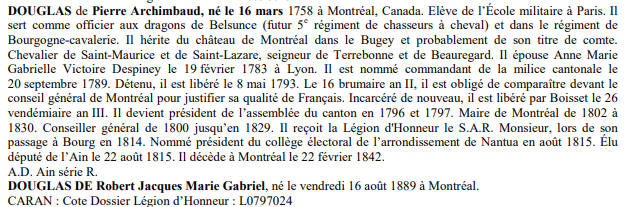
Pierre Archimbaud de Douglas was born on March 16, 1758 in Montreal, Canada. He was a student at the Military School in Paris and served as an officer in the Dragons de Belsunce (later the 5th Regiment of Chasseurs à Cheval) and in the Bourgogne-Cavalerie regiment. He inherited the Château de Montréal in the Bugey region and probably his title of Count. He was a Knight of the Order of Saint-Maurice and Saint-Lazare, lord of Terrebonne and Beauregard. He married Anne Marie Gabrielle Victoire Despiney on February 19, 1783 in Lyon. He was appointed commander of the cantonal militia on September 20, 1789. He was detained and released on May 8, 1793. On 16 Brumaire Year II, he was forced to appear before the General Council of Montréal to justify his French nationality. He was imprisoned again but released by Boisset on 26 Vendémiaire Year III. He became president of the canton assembly in 1796 and 1797, and was mayor of Montréal from 1802 to 1830. He was a general councilor from 1800 until 1829. He received the Legion of Honor from S.A.R. Monsieur during his visit to Bourg in 1814. He was appointed president of the electoral college of the Nantua district in August 1815, and was elected deputy of Ain on August 22, 1815. He died in Montréal on February 22, 1842.
Robert Jacques Marie Gabriel de Douglas was born on August 16, 1889 in Montréal. According to CARAN, his
Legion of Honeur
dossier has the file code L0797024. There is no further information
provided about him in the register. However, see
above.
See also:
• The Douglas Family in France
|