This page is a stub.
You can help improve it.
The Earls of Orkney and The Douglas connection
The Orkneys and Shetland, and the Earl’s Palace have a connection with
the Douglas clan.
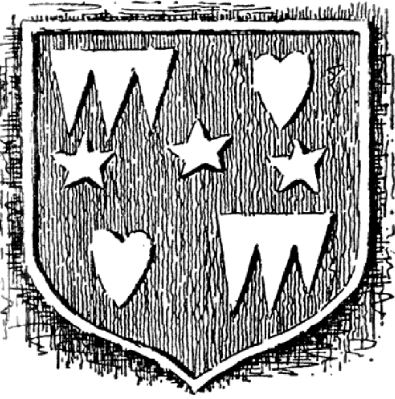
On the tombstone, in St Magnus Cathedral, of George Douglas, who died in 1611, and Elizabeth Douglas, his spouse, who died in 1630, is a shield bearing: Quarterly first and fourth, three piles, second and third, a heart; overall all many mullets in fess.
In 1643, William Douglas, the
7th Earl of Morton (1582-1648) was granted the “regalities” (that is
the rights and privileges due to the king) in Orkney and Zetland, as
Shetland was known, by King Charles I. Morton was Lord High Treasurer of
Scotland from 1630-1636 and one of the King’s strongest supporters. He
had sold his Dalkeith estate so he could advance £100,000, a massive sum
at the time, to the king at the outbreak of the War of the Three
Kingdoms (also known as the English Civil War). When Charles lost the
war Morton retired to Kirkwall and died there in 1648 of natural causes.
His son died the next year, and the 9th Earl inherited.
He was
succeeded by his son William Douglas as 9th earl (d 1681). The grant of
Orkney and Shetland to the latter was disputed and they reverted to the
Crown. Douglas, in 1672, resigned the Barony of Dalkeith. Sir James
Douglas (d 1686) of Smithfield succeeded his nephew William and in 1669
James' son James Douglas (d 1715), 11th Earl of Morton, was granted
Orkney and Shetland.
James 11th Earl, died unmarried as did his
brother Robert, 12th Earl. Their brother, George 13th Earl, was Vice
Admiral of Scotland.
The succession passed through this side of
the family to James Douglas (1703-1768) 14th Earl of Morton who in 1742
obtained an Act of Parliament investing the Earldom of Orkney and
Lordship of Zetland in himself and his heirs. In 1766 he sold the
islands to Sir Laurence Dundas of Kerse in Stirling, descendant of the
Dundas family of Fingask and ancestor of the Earls of Zetland.
The Earl of Orkney was originally a Norse jarl ruling the the
archipelagos of Orkney and Shetland (Norðreyjar). The second earldom was
created in 1581 by James VI of Scotland. The Stewart earls were based at
Kirkwall Castle, which had been built by Henry I Sinclair. It was
demolished on the forfeiture of the title in 1614.
William Sinclair (1410–1484), last of the Sinclair Jarls, 1st
Earl of Caithness and 3rd Earl of Orkney married three times, first to
Lady Elizabeth Douglas, daughter of
Archibald Douglas, 4th Earl of Douglas with whom he had:
•
William Sinclair, 2nd Lord St. Clair (1436) was, in the opinion of the
father, a wastrel, wherefore he was disinherited. His family received
only the Castle of Ravenscraig in
Fife.
• Catherine Sinclair, married Alexander Stewart, Duke of Albany
• (second daughter, name not recorded)
He married (second)
Marjory, daughter of Alexander Sutherland of Dunbeath, and had 15
children.
The last creation of the earldom was in favour of the
man who in 1735 would become the first Field Marshal of Great Britain,
Lord George Hamilton, the fifth son of William Douglas, Duke of
Hamilton. The peerage was created with "remainder to the heirs
whatsoever of his body", meaning that the title can be passed on through
both male and female lines. The title passed to the O'Brien family, then
to the Fitzmaurice family, and later to the St John family. The
subsidiary titles of Viscount of Kirkwall and Lord Dechmont were created
at the same time as the earldom. The present earl holds the subsidiary
titles of Viscount of Kirkwall and Lord Dechmont. Both subsidiary titles
were created at the same time as the earldom, in 1696.
•
William Douglas of Egilsay, Orkney (and of Spynie?) (c. 17th
Century) was a Burgh commissioner for Shetland in 1667.
•
Sir Alexander Douglas (d. January 1718) was a Burgh and
Shire Commissioner of Orkney and Shetland for the Parliament of Scotland
and was also the first MP to represent the constituency.
•
Admiral Sir James Douglas, of Springwood Park, was M.P. for Orkney and Shetland 1754-1768.
•
George Douglas, 13th Earl of Morton, was MP for Shetland, and was succeeded by his son,
Colonel Robert Douglas (c.1703 - 30 April 1745) of St Ola, Orkney who was a British Army officer and Scottish politician who sat in the House of Commons from 1730 to 1745.
He died unmarried in the Battle of Fontenoy on
30 April 1745.
•
James the Gross, 7th Earl of Douglas, married Lady Beatrice Sinclair, daughter to Henry II Sinclair, Earl of Orkney
• The Hon. Arthur Gascoigne Douglas D.C.L. (5 January 1827– 19 July 1905) was Bishop of Aberdeen and Orkney in Scotland from 1883 to 1905.
The Douglas family in Orkney
And the Traill and Baikie
connections
From Alexander Douglas,(1) who was Bishop of
Moray in 1606, the Douglases will be traced to Janet Douglas, daughter
of William Douglas and Elizabeth Traill, who was a daughter of Thomas
Traill, third of Holland, and the sister of William Traill, first of
Frotoft.
The Orkney Douglases are said to have been related to
an Earl of Morton, which possibly may not add lustre to the good name of
Douglas; it has been remarked, by one who probably knew more of the
history of Orkney than any other person, that the Earl(2) was the worst
King Stork of all the Donataries.
There were many of them
grasping, greedy and unscrupulous when it came to exacting Skatts,
duties, &c.; it may be hoped, if any of them dropped into the haven of
Purgatory, that they appreciated the respite in such a mild climate.
There were several Douglases who will not come in the line of descent in
tracing from Bishop Alexander Douglas toJanet Douglas, who was known as
the heiress of Egilshay, such as Sir James Douglas, the Admiral, and at
one time M.P. for Orkney; Colonel Robert Douglas, also M.P. for Orkney,
who was killed at the Battle of Fontenoy, and many more or less
distinguished persons known to Orkney folk in their day.
Alexander Douglas, Bishop of Moray, had a son known as — Alexander
Douglas, of Spynie, and his son was known as — William Douglas,
Chamberlain of Orkney, he married Marjorie Monteith, daughter and
heiress of Patrick Monteith and Marion Smith, a daughter of Patrick
Smith, of Braco; their son, and heir of line of Monteith of Egilshay,
got the Island in 1688, and was known as — Sir Alexander Douglas, of Egilshay, he married Janet Scott, the widow of Alexander Crookshank,
of Warriston, about 1688; their son was — William Douglas, who married
Elizabeth Traill; (sister to William Traill, first of Frotoft; and the
grand-aunt of Lieutenant Gilbert Traill, R.N their daughter, Janet
Douglas, was heiress to her grandfather, Sir Alexander Douglas, and the
grandmother of Frances Baikie, a daughter of Robert Baikie, seventh of
Tankerness, who was a son of Janet Douglas and James Baikie, sixth of
Tankerness. Frances Baikie was therefore her husband's second cousin
once removed, and he was first cousin once removed of his wife's
grandmother, Janet Douglas.
The Island of Egilshay passed twice
through heiresses, first from Monteiths to the Douglases, then from the
Douglases to the Baikies, and formed part of the Baikie of Tankerness
Estates.
Lieutenant Gilbert Traill, R.N., and Frances Baikie,
previously mentioned, had four children; their eldest son, G. F. Traill,
J.P., had seven children; two of the daughters are dead, but Frances B.
Traill, Anne Christina Traill and Rosetta J. R Traill are alive; the
elder of the two sons is dead, the younger, Gilbert F. Traill, of
Ceylon, is alive, and has four (3) children alive, two daughters,
Kathleen D. Traill and Norah S. Traill, the two(4) sons are, Gilbert B. Traill and Colin B. Traill (5) The other children of Lieutenant Gilbert Traill, R.N., and Frances Baikie, are: — Mary B. B. Traill, who died
unmarried, and Elizabeth R. G Traill, who is married, and has six
children; the fourth, and youngest, son is Fleet Engineer Thomas W.
Traill, R.N, who is married; he has one son, R. F. Traill, Lieutenant,
who is therefore the great great grandson of Janet Douglas, who was
Frances Baikie's grandmother. The relationship of the descendants of
Lieutenant Gilbert Traill, R.K, and Frances Baikie to the
Douglases is not only because Janet Douglas was Frances Baikie's
grandmother and Lieutenant Gilbert Traill's first cousin once removed(6)
Some persons may desire to trace the Douglases from an earlier date
than the sixteenth century when Bishop Alexander Douglas was born; the
writer refers them to William de Douglas, who lived in the twelfth
century. Even those who have an insatiable love of genealogy will be
amply rewarded by a diligent study of the Douglas pedigree and history
for the last seven hundred years.
Notes:
1.
He was the second Protestant Bishop of Moray, he died in 1623,
was
buried in the aisle of St. Giles Church, Elgin, where a monument was
erected by his widow, a daughter of the Laird of Innes.
2.
Probably the 10th Earl. Although all the Douglases may not have been
Saints, there were many good ones who served their Country well.
3.
Another son therefore " four " should read five.
4.
"Two " should read three.
5. The other son is
Ian B. Traill.
6. Lieutenant Gilbert Traill,
R.N., was a son of Thomas Traill, second of Frotoft, who was a son of
William Traill, first of Frotoft, whose wife was Elspeth Liddell,
daughter of William Liddell, whoso wife was Margaret Graham, daughter of
Harie Graham, who was a son of John Graham, who was a son of Bishop
George Graham, who was a son of George Graham, of Inchbrakie, who was a
son of Patrick Graham, of Inchbrakie, who was a son of William Graham,
first Earl of Montrose, who was a son of William Graham, second Lord
Graham, and his wife Anne Douglas, (from whom the Earls, Marquises and
Dukes of Montrose are descended) daughter of George Douglas, fourth Earl
of Angus, who died in 1463. Therefore Lieutenant Gilbert Traill, R.N.,
and Frances Baikie's children are eleven generations from Anne Douglas.
Anne Douglas had several sisters ; the following may be of interest with
reference to four of them. Her sister Isabella, married Sir Alexander
Ramsay, ancestor of the Earl of Dalhousie ; her sister Elizabeth,
married Sir Robert Graham, ancestor of John Graham, of Claverhouse,
Viscount Dundee ; her sister Margaret, married Sir Duncan Campbell, of
Glenorchy, ancestor of the Earls of Breadalbane, and her sister Janet's
first husband was David Scott, younger of Buccleuch, ancestor of the
Dukes of Buccleuch.
A good record of marriages for five sisters. They
have now many descendants among the nobility and gentry in whose veins
the Red Douglases blood courses. |