|
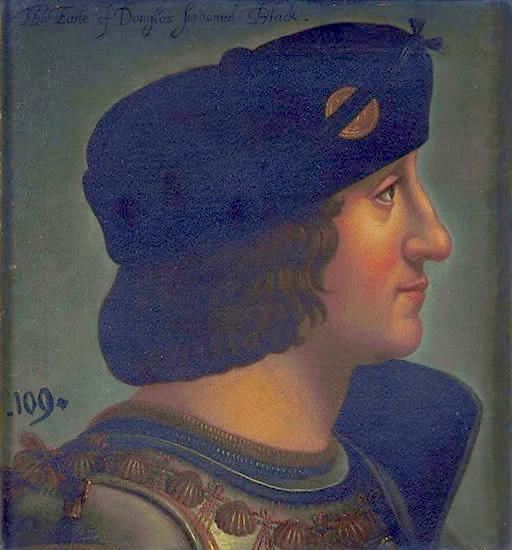
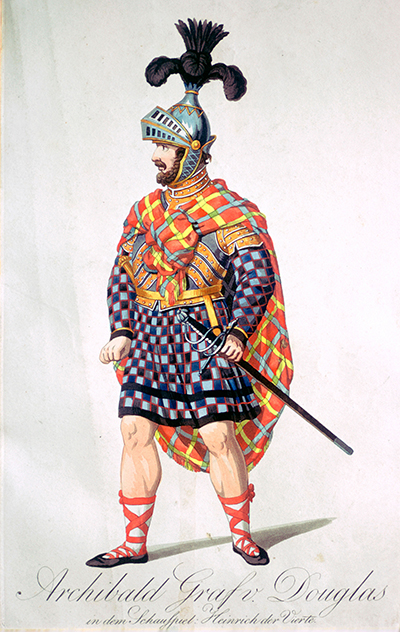
Archibald Douglas, 4th Earl of Douglas, Duke of Touraine (c. 1369 – 17 August
1424), was a Scottish nobleman and warlord. He is sometimes given the epithet
"Tyneman" (Old Scots: Loser), but this may be a reference to his great-uncle Sir
Archibald Douglas. He was 2nd son of Archibald
Douglas, 3rd Earl of Douglas.
In 1390 he married Margaret Stuart, daughter of Robert
III. He held Edinburgh
against the English when Henry IV invaded in 1400. In 1402 Douglas was tried and
acquitted of the murder of David Stuart
, Duke of Rothesay, heir apparent to the throne. Later that year Douglas led a
Scottish army against the English and was taken prisoner by Sir Henry Percy
at Homildon Hill.
He was then induced to join the Percy conspiracy against Henry IV, but at the
battle of Shrewsbury (1403) he was taken
prisoner by Henry and held until ransomed in 1408.
From 1412 to 1422, Douglas continued his border warfare against England and
was a member of several delegations of Scottish nobles who tried,
unsuccessfully, to ransom their young king, James
I , from the English.
In 1423 he and his Scottish contingent joined the French against the English.
He was made lieutenant general of the French army and Duke of Touraine. In 1424
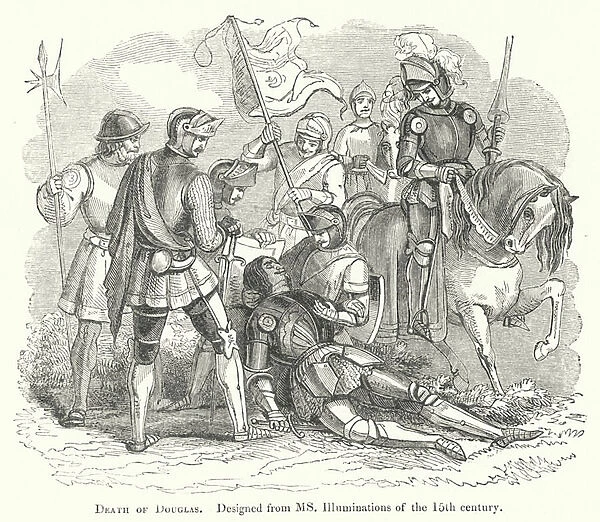
the allies were defeated at Verneuil, and Douglas was
slain.
Archibald 'Tyneman' Douglas: A Life of Ambition
and Loss
Archibald Douglas, the fourth Earl of Douglas and briefly
the first Duke of Touraine, lived a life defined by the powerful influence
of his family and a relentless pursuit of personal and dynastic advancement.
Born around 1369, the second son of the formidable
Archibald 'the Grim', his career was a
tapestry woven with strategic marriages, shifting allegiances, and a string
of military engagements that ultimately earned him the grim epithet 'Tyneman'
– the loser.
Douglas's ascent began in 1390 with a politically
advantageous marriage to Margaret, daughter of
King Robert III. This union,
facilitated by his ambitious father, brought with it the lordships of
Douglas, Ettrick, Lauderdale, and Romanock, solidifying the family's already
considerable power. A decade later, in 1400, his influence was further
cemented by his appointment as keeper for life of
Edinburgh Castle.
The same
year marked a significant turning point with the death of his father,
propelling Archibald to the earldom and inheriting the vast Douglas estates(1)
spanning both the eastern and western borders, as well as the barony of Bothwell through his mother, Jean Moray. Displaying the assertive nature of
his lineage, the new Earl of Douglas swiftly asserted his authority as
warden of the marches. In February 1401, he successfully rebuffed Henry IV's
threatened invasion of Scotland, notably clashing with the Earl of March and
Henry Percy. The ensuing conflict at Cockburnspath saw many English
followers dispersed and captured, with Douglas boldly pursuing them to the
very gates of Berwick, where he captured the lance and pennon of Thomas
Talbot. Henry IV's subsequent personal siege of Edinburgh Castle in August
was met with staunch resistance from the Duke of Rothesay and Douglas,
supported by the Duke of Albany's forces at Calder Moor, ultimately forcing
the English king to retreat.
The year 1402 witnessed a darker chapter
in Scottish history, one in which Douglas played a controversial role. The
death of the heir-apparent, the Duke of Rothesay, at
Falkland Palace, where
he had been confined following his arrest near St. Andrews at the behest of
Albany and Douglas, cast a long shadow. Their close collaboration, evidenced
by a meeting at Culross and a joint remission granted by parliament shortly
after Rothesay's demise, strongly suggests complicity in Albany's apparent
ambition to seize true sovereignty. While contemporary chroniclers like
Wyntoun offered alternative explanations, later accounts, notably by Major
and in the 'Book of Pluscarden', explicitly accused them of murder. The fact
that Albany and Douglas themselves confessed to Rothesay's incarceration in
the preamble of a subsequent statute further strengthens the case for their
involvement. King Robert III's decision to send his remaining son, James,
out of the kingdom soon after can also be interpreted as a testament to his
fear of Albany's machinations. The detailed narrative of Rothesay's arrest,
imprisonment, and death by starvation, coupled with his pauper's burial,
lends a chilling authenticity to the accusations. While the precise
motivations of Douglas remain somewhat obscure, the overarching ambition of
his house, a trait seemingly inherent in the Douglas lineage, likely played
a significant part in his agreement with Albany. A glimpse into these murky
dealings is perhaps offered by the 'Book of Pluscarden's' account of Sir
David Fleming's assassination upon his return from escorting the young James
to France, allegedly at the hands of the Earl's brother.
The year
1402 also saw a series of Scottish raids into England, largely instigated or
led by Douglas in retaliation for English incursions. While Sir John
Haliburton returned from one such raid with considerable plunder, Sir
Patrick Hepburn, a figure deeply esteemed by Douglas, met a tragic end at
Nisbet Muir, falling with the flower of the Lothians. Driven by vengeance,
Douglas, alongside Murdoch (Albany's son), and the Earls of Angus and Moray,
led a substantial force into Northumberland. However, at
Homildon Hill on 24
September 1402, they were met by the Earl of March and Hotspur, who
decisively routed the Scots using English archers to devastating effect.
Douglas himself was wounded multiple times and lost an eye, becoming one of
the many prominent Scottish nobles captured, including Murdoch and the Earls
of Moray and Angus. A French effort to ransom Douglas and other captured
knights proved unsuccessful.
The following year brought a dramatic
shift in English politics. Henry IV's refusal to allow Northumberland and
Hotspur to release their Scottish prisoners without his consent, coupled
with his grant of Douglas lands in Scotland to the Percies, fueled
resentment. The Percies, feeling inadequately rewarded for their role in
securing Henry's throne, formed an alliance with Owain Glyndŵr and even
propagated rumours of Richard II's survival in Scotland. Douglas, enticed by
the promise of Berwick and part of Northumberland, joined this formidable
conspiracy and fought alongside his former captor, Hotspur, at the pivotal
Battle of Shrewsbury on 23 July 1403. Despite displaying remarkable personal
courage, celebrated by both English and Scottish writers who noted his
pursuit of Henry himself, Hotspur was slain, and Douglas was once again
severely wounded and taken prisoner.
Douglas's final release from
English captivity was not achieved until June 1408. During his imprisonment,
he made several visits to Scotland to negotiate his ransom, each time
leaving a significant number of hostages from the families of his principal
vassals as surety for his return. The detailed list of these hostages in a
1407 indenture powerfully illustrates the immense power wielded by the
Douglas family and the high value placed upon their leader. His eventual
release was secured through the influence of the Earl of March and
Haliburton of Dirleton, contingent upon a substantial ransom and the
restoration of the March lands, though Douglas retained Annandale and
Lochmaben Castle. Upon his return, he reaffirmed his alliance with Albany in
1409, a bond further strengthened by the marriage of his daughter Elizabeth
to John Stewart, Earl of Buchan, Albany's second son.
In 1412,
Douglas embarked on his first journey to Paris, a reflection of his family's
long-standing pro-French stance, a sentiment reinforced by French efforts to
secure his release from English captivity. Despite initial setbacks due to
adverse winds, Bower recounts a tale of divine intervention after Douglas
made an offering at Inchcolm, granting him safe passage to Flanders and then
to Paris. There, he forged a treaty with John the Fearless, Duke of
Burgundy. While he intended to return to the continent the following year, a
safe-conduct granted by Henry V went unused.
For the subsequent
decade, Douglas pursued a complex and often contradictory policy. He
intermittently engaged in border warfare against England while
simultaneously negotiating the ransom of the young Scottish King James I,
held captive by Henry V. In this endeavor, Douglas appeared more sincere
than Albany, whose vested interest in prolonging his regency likely made him
ambivalent, if not actively opposed, to James's release. Douglas led an
invasion of England in 1415, burning Penrith. In 1417, he commanded the
siege of Roxburgh while Albany besieged Berwick. The failure of both sieges,
lifted by the strong English army led by the Dukes of Bedford and Exeter,
earned this campaign the ignominious title of the "Foul Raid." Between these
invasions, Douglas had travelled to England with other nobles to discuss
James I's release, but they failed to reach an agreement with the English
king.
In 1420, Douglas launched a third attack on the English
borders, burning Alnwick. However, the following year, Henry V met him at
York and successfully swayed his allegiance with a yearly pension of £200,
in exchange for Douglas providing two hundred horsemen. This shift in
loyalty was likely influenced by the death of Albany and the subsequent
transfer of the regency to his less capable son, Murdoch. Yet, this
defection proved temporary. The traditional alliance between Scotland and
France remained a powerful force. In 1419, shortly before Albany's death,
the Count of Vendôme, acting on behalf of the incapacitated King Charles VI
and his son the Dauphin (later Charles VII), implored Scotland for support
against the English, who had never fully recovered from the devastating
defeat at Agincourt and now controlled much of northern France. In response,
the Scottish Parliament voted to send a force of seven thousand men under
the command of the Earl of Buchan (Douglas's son-in-law),
Archibald, Earl of Wigtown (Douglas's son), and Sir John Stuart of Darnley. The ensuing victory
at Beaugé in 1421, where the Duke of Clarence was killed and the English
were routed, was largely attributed to the Scottish troops. Buchan was
rewarded with the prestigious title of Constable of France, Wigtown received
the fief of Longueville, and Darnley that of D'Aubigny.
In a
counter-move to undermine Scottish support for France, Henry V brought the
captive King James I with him to France, hoping to exploit the Scots'
renowned loyalty. However, accounts suggest James refused to be used in this
manner, famously stating that he was no king without a kingdom. Another
account credits Buchan with refusing to serve a king held prisoner. The
subsequent defeat of the Franco-Scottish forces at Crévant in Burgundy in
1423, where Darnley was captured and many Scots were killed, prompted a
fresh appeal for reinforcements. The Earl of Buchan returned to Scotland in
May 1423 and persuaded his father-in-law, Douglas, to lead the new
contingent.
Douglas landed at La Rochelle with ten thousand men and
joined the court of Charles VII at Chatillon, accompanying the king to
Bourges. There, he was appointed Lieutenant-General of the French army and
granted the title of Duke of
Touraine for himself and his male heirs. He
swore fealty on 19 April 1423. While the French chamber of accounts
initially resisted ratifying the grant due to its illegality without
parliamentary consent and its infringement on royal domains, the king's
guarantee ultimately secured their reluctant agreement. The people of
Touraine also expressed their displeasure at being placed under foreign
rule, but assurances from the king that they would be governed gently
eventually led to their acquiescence. Douglas was received with customary
honours at Tours on 7 May, making a grand entry, taking oaths, and being
made a canon of both the cathedral and the church of St. Martin. He soon
appointed his cousin, Adam Douglas, as governor of Tours.
However,
Douglas's ducal honours were short-lived. He was soon compelled to confront
the Duke of Bedford, the English regent in France, who was vigorously
prosecuting the war on behalf of his young nephew, Henry VI. The castle of
Ivry in Perche, besieged by Bedford, surrendered in July 1424 after French
relief arrived too late. Around the same time, the French captured
Verneuil,
employing a stratagem allegedly devised by Douglas involving the deception
of the inhabitants by posing some Scots as English prisoners. Upon learning
of Verneuil's capture, Bedford immediately advanced to retake it, sending a
herald to Douglas announcing his arrival for a "drink." Douglas responded
that he had come from Scotland to meet Bedford and welcomed the encounter.
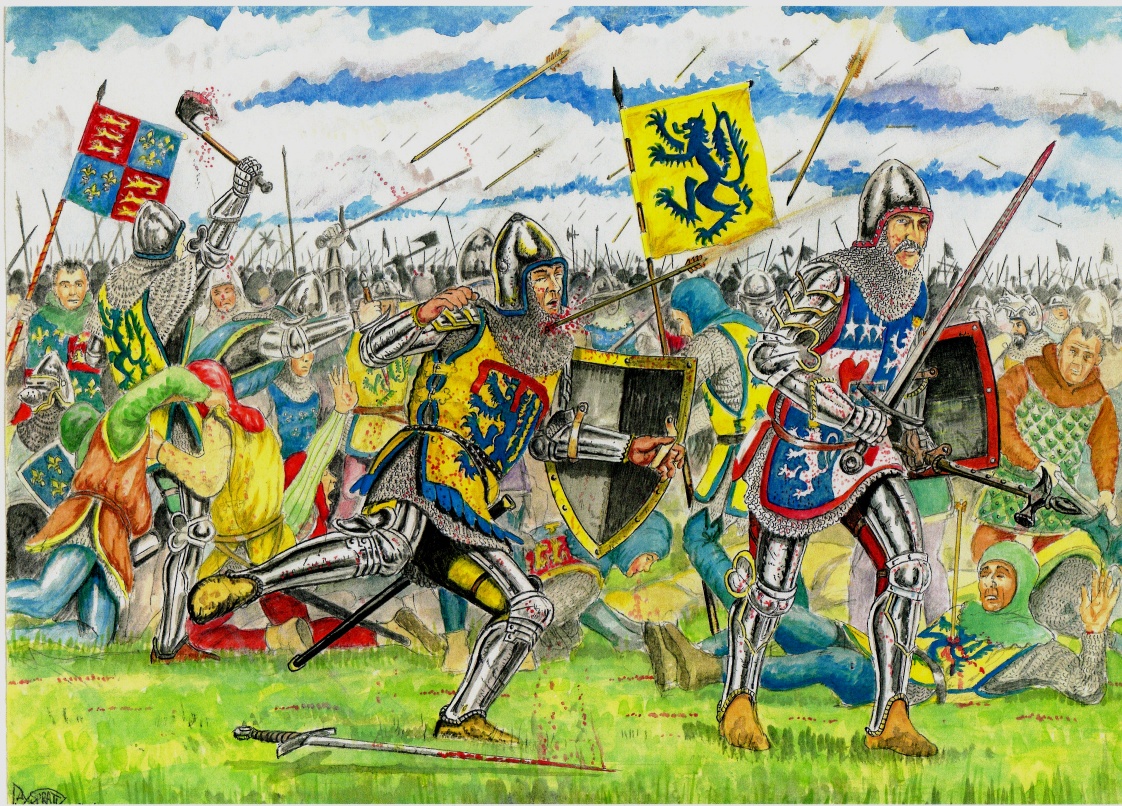
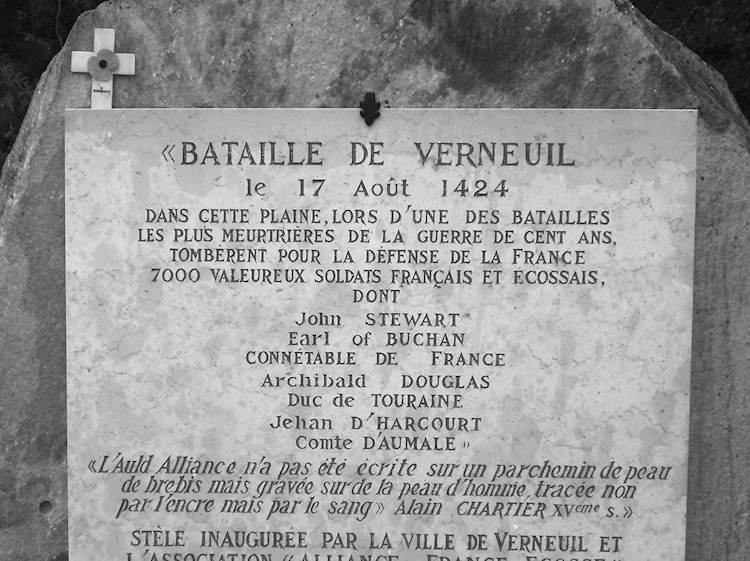
The ensuing Battle of Verneuil on 17 August proved disastrous for the
Franco-Scottish forces. As was often the case, English archers gained an
initial decisive advantage, which the men-at-arms exploited, leading to a
complete rout. The slaughter was immense, with an estimated 4,500 French and
Scots slain, including Douglas, his son-in-law Buchan, his second son James
Douglas, and numerous other leaders. The defeat sparked recriminations
between the French and Scots, who accused each other of rashness. Some
accounts even suggest a dispute over command, foolishly resolved by
entrusting it to the young and inexperienced Duke d'Alençon. The small
remnant of the Scottish forces formed the nucleus of the celebrated Scots
Guard, but no further large contingents were sent to France after this
devastating loss.
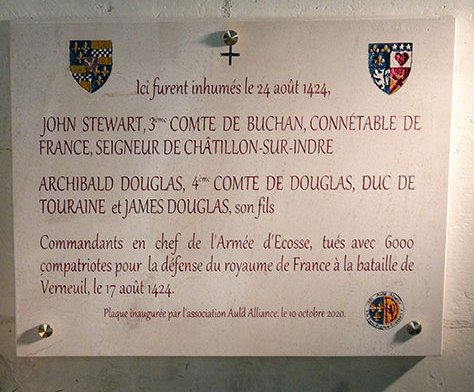
Archibald 'Tyneman' Douglas was honourably buried
at Tours. The outcome of Verneuil indelibly marked him as an unsuccessful
general, earning him his unfortunate by-name in Scottish history for his
consistent losses from Homildon to Verneuil, a stark contrast to the almost
invariably victorious Earl of March. Furthermore, his actions are difficult
to reconcile with patriotic ideals. His conspiracies with Albany against
Robert III and his sons are not mitigated by his later support for James I's
release, which appears to have stemmed more from a preference for a young,
malleable king than genuine loyalty. Ultimately, ambition seems to be the
driving force behind Douglas's complex and often contradictory career. He
readily aligned himself with both England and France, Henry V and Hotspur,
pursuing any cause he believed would benefit his powerful house. While
possessing personal courage, a common trait of his era, the claim of
"wariness and circumspection" attributed to him by Hume of Godscroft seems
more applicable to his dynastic maneuvering than his military leadership, a
judgment history has largely confirmed.
Family Father: Archibald
Douglas, 3rd Earl of Douglas.
In 1390 he married Margaret Stewart, daughter of Robert
III.
Children
- Elizabeth Douglas b: ABT. 1394, Died: Bef 1451
Married (1): John Stewart, Earl of Buchan; Died: 17
Aug 1424 Battle Of Verneuil,
(2): Sir Thomas Stewart
(3): William Sinclair, Earl of Orkney and Caithness - Archibald "of Touraine" Douglas, Born: Abt 1390 Of, Douglas,
Lanarkshire. Died: 26 Jun 1438 Restalrig; Married: Euphemia Graham, Countess
of Douglas
- James Douglas, Earl of Abercorn(2), Born: Abt 1392 Of, Douglas,
Lanarkshire, Scotland Died: 17 Aug 1424 Battle Of Verneuil, Maine-Et-Loire,
France Bur.: 24 Aug 1424 Tours Cathedral, Tours, Indre-Et-Loire, France;
Married: Beatrice (or unmarried?)
- Margaret Douglas, Born: [1394], Scotland; Married: William Earl Of Orkney
- Helen Douglas, Born: [1396], Scotland; Married: Alexander Lauder
- Mary Douglas, Born: [1398], Scotland; Married: Sir Simon Glendoning of
Parton.
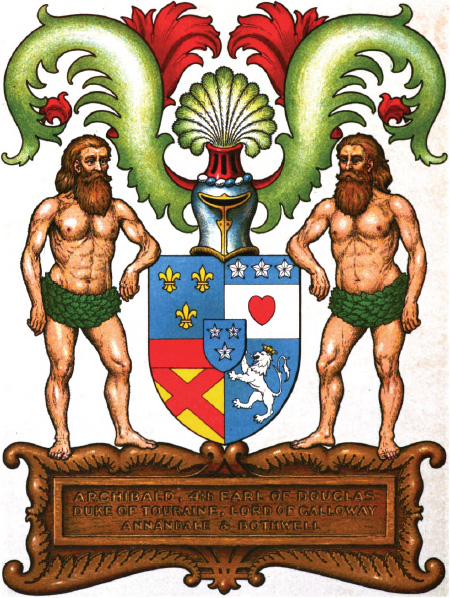
The Heraldry of The Earl of Douglas, Duke of Touraine
One of the leaders of the Scottish expeditionary force was Archibald Douglas,
4th Earl of Douglas (called Archambault Douglas in French texts). Obviously,
Charles VII had little money with which to reward his supporters, although his
supporters were few. One way to express his gratitude was to bestow honors; and
giving fiefs was a way to help them support the costs of war far from home.
The earl of Douglas was made Constable of France in 1421. By Letters Patent of
April 19, 1424, he was given the duchy of Touraine to hold in peerage by him and
his heirs male of the body (Père Anselme 3:231), and gave homage the same day.
The earl was killed at the battle of Verneuil on August 17, 1424. His only son
Archibald, who had been made count of Longueville, succeeded as 5th earl of
Douglas; he had left France for Scotland in 1423, and at the time of his
father's death a rumor reached France that he had died without children; the
king assumed the title extinct and gave the duchy to Louis d'Anjou on Nov. 21,
1424. When the news were disproved, the 5th earl was allowed to retain the title
of duke of Touraine (Dictionary of National Biography, s.v. Archibald Douglas,
Père Anselme, 3:231). He died in 1439. His only two sons, William and David,
were executed for treason in 1440 in Edinburgh and the descent of the 4th earl
was extinct.
Heraldry
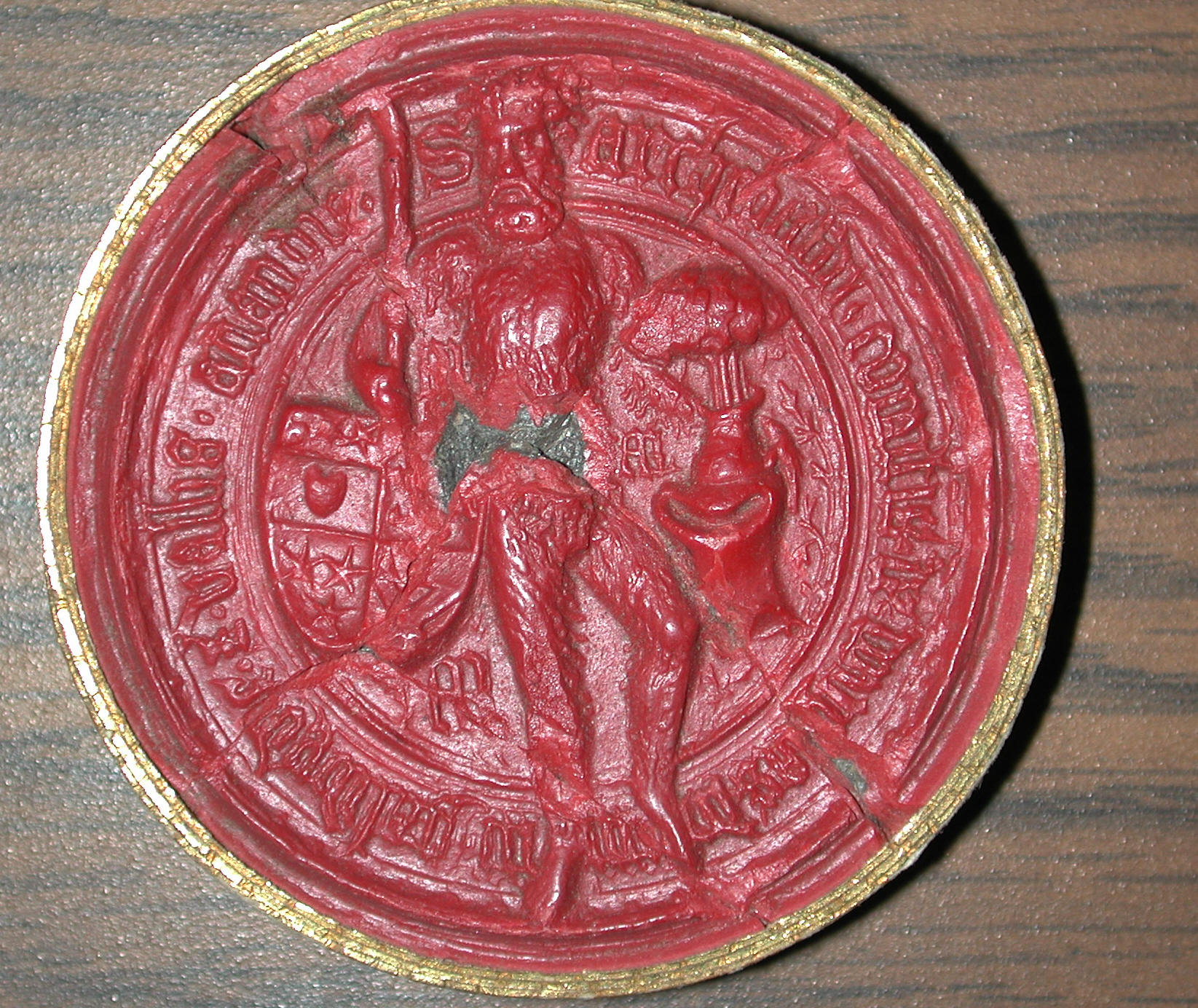
The 4th earl of Douglas used two arms on his seals: one was Quarterly Douglas
and Galloway, en surtout Murray of Rothwell (Stevenson and Wood), another was
Quarterly Douglas, Galloway, Murray and Annandale (Catalogue of Seals, 16054).
One seal, attributed to him, shows a modified version: Quarterly France,
Douglas, Annandale, Galloway with the title of duke of Touraine, earl of Douglas
and of Longueville in the legend. However, both Laing (suppl. 282) and the
catalogue of the British Museum (16055) date it to 1421, which is impossible;
moreover, the title of count of Longueville was given to the 4th earl's son. I
suspect that the latter seal belonged to Archibald, 5th earl. In any event, the
4th earl did use those arms with a French quarter, since a seal of his widow
Margret, daughter of Robert III king of Scots, shows Quarterly France, Douglas,
Annandale, Galloway impaling Scotland, and the title of duchess of Touraine (on
a document dated 1425; Laing).
Both the 5th and 6th earls used the same shield with a quarter of France and the
title of duke of Touraine (Stevenson and Wood). No other earl of Douglas did so.
It is not clear where the escutcheon comes from. This was the first time that a
French king conferred a peerage on someone who was not of royal blood. Hitherto,
the differenced arms of France became associated with the peerage, so that the
arms of Touraine, Burgundy modern, Anjou, Berry, Alençon, as provinces, are all
differenced versions of the arms of France. In other words, there were no arms
of Touraine proper to be borne by a non-royal.
Although there is no evidence to that effect, I suspect that the reason for the
escutcheon is the same as that for the escutcheon of the Stuarts of Darnley,
which is well documented, and for the quarter of the Kennedy of Bargany. Thus,
the escutcheon of France is not a mark of peerage, and does not represent the
duchy of Touraine (or the seigneurie of Aubigny in the case of the Darnley), but
a special augmentation conferred by the king independently of any fief.

Notes:
1. The Douglases had extensive land holdings
throughout Scotland, and indeed elsewhere, won and lost over the centuries.
Many are listed here>>>
2. Earl of Abercorn? I am not sure that this
is correct!
Sources:
Sources for this article include:
• Dictionary of National Biography, 1885-1900, Volume 15
Further details on this entry would be
welcome.
|
|