This page is a stub.
You can help improve it.
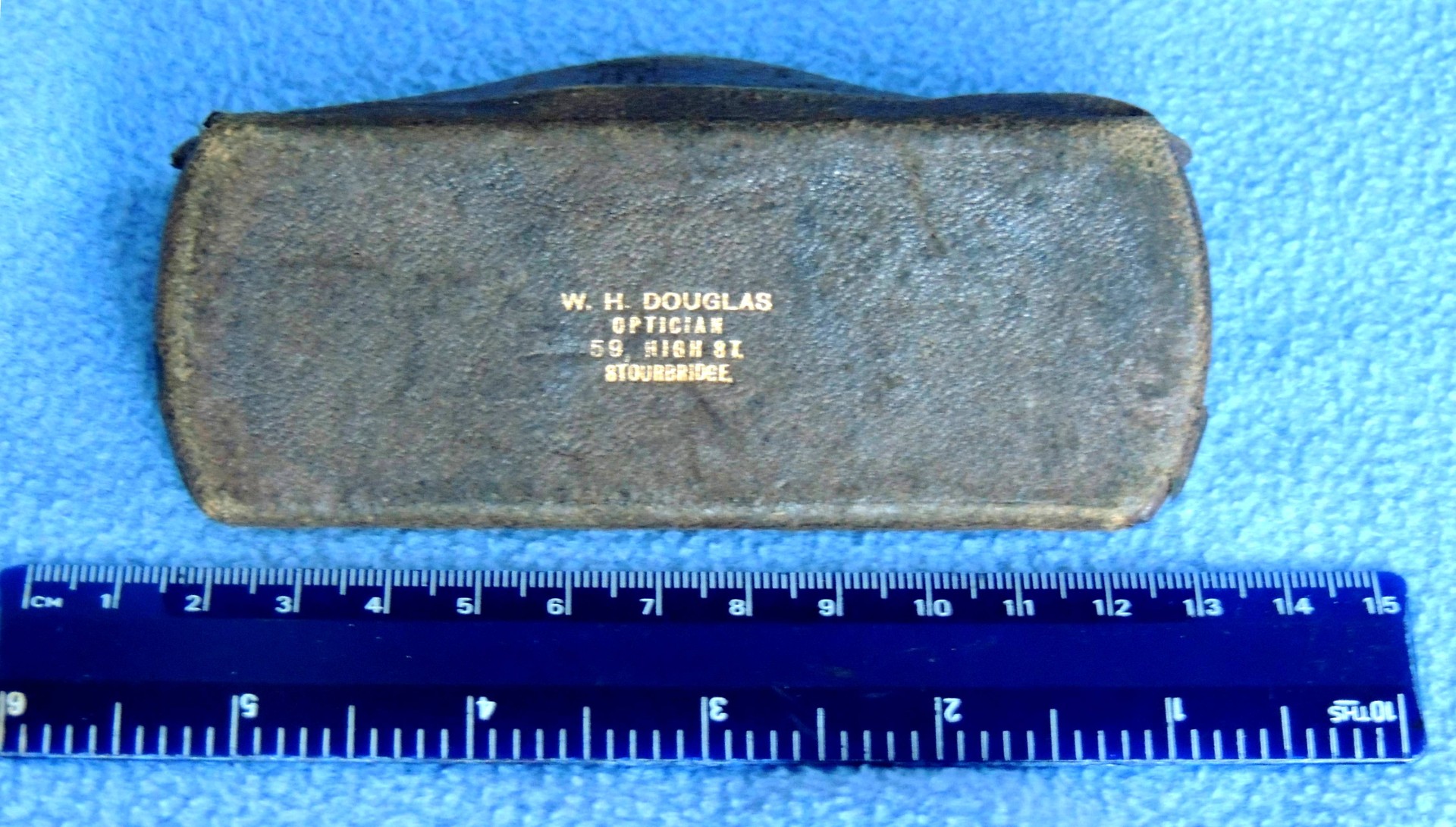
William Henry Douglas's premises at 59 High Street, Stourbridge was
initially for his optician business, but by the early 1920s this line of
business had been abandoned and he specialised in watchmaking instead.
William Henry Douglas, of Stourbridge,
Worcestershire, registered a patent in the US for 'certain new and
useful Improvements in Stop-Watches', dated December 27,
1892. He sold a patent for his double chronograph to The
English Watch Company of 27 September 1881 and his stock
of finished and unfinished movements and materials.
A copy of his watch is said to have been given to Edward VII on or about
his coronation and is in the Royal Collection.
Specification forming part of Letters Patent No. 488,710, dated December
2?', 1892.
Application to the United States patent Office filed March 12, 1892.
Serial No. 424,641. (No model) To whom it may concern:
Be it known that I, WILLIAM HENRY DOUGLAS, a citizen of Great Britain,
residing at Stourbridge, in the county of Worcester, and country of
England, have invented certain new and useful Improvements in
Stop-Watches; and I do hereby declare the following to be a full, clear,
and exact description of the invention, such as will enable others
skilled in the art to which it appertains to make and use the same.
This invention relates to stop Watches and it consists in the novel
construction and combination of the parts hereinafter fully described
and claimed.
In the drawings: Figure 1 is a rear View of the stop mechanism. Fig. 2
is a front view of the Watch showing the additional dials and pointers.
Fig. 3 is asectional side view of the disengaging mechanism. Fig. 3A is
a detail showing a modification of a portion of the disengaging
mechanism.
William Henry Douglas and His Family
William Henry Douglas, a skilled watchmaker and jeweler, entered the Lewis family in 1873 when he married Charlotte Elizabeth Lewis, daughter of James William Lewis. Their union tied the Douglas name to the long-lived and complex Lewis lineage, and together they built a family that carried both traditions forward.
- William and Charlotte had four children, raising them first in Birmingham
and later in Pedmore, a suburb of Stourbridge. By 1911, the family had settled there, reflecting the Douglas household’s upward mobility and stability compared to some of Charlotte’s siblings.
- Charlotte lived a long life, dying in 1933 at age 83 in Edgbaston, Birmingham, of carcinoma of the liver. She left an estate valued at £3,687—a substantial sum that reflected the family’s prosperity.
- William Henry Douglas, through his craft as a jeweler, provided the foundation for this stability, anchoring Charlotte’s branch of the Lewis family in the Midlands.
The Lewis Connections Around Him
William Henry Douglas’s marriage brought him into a family marked by both tragedy and resilience:
- His father-in-law, James William Lewis (1810–1905), had endured the deaths of two wives and several children before marrying Charlotte’s mother,
Mary Ann (1830–1906).
- Charlotte’s siblings formed other branches:
- Fanny Maria Lewis married jeweler Richard Whitefield Row in 1874. They had five children and moved to Worcester, where Fanny died in 1919.
- Charles Henry Lewis, Charlotte’s brother, married Georgina Tutill in 1878 and had one daughter, Georgette Lewis. Charles died young in Davos, Switzerland, in 1886, leaving Georgina widowed and Georgette fatherless.
Notes:
• The Douglas-Osborn family is said to be descendants of the
Douglas family of Witham. See
Lt Gen Archibald Douglas of Witham
|