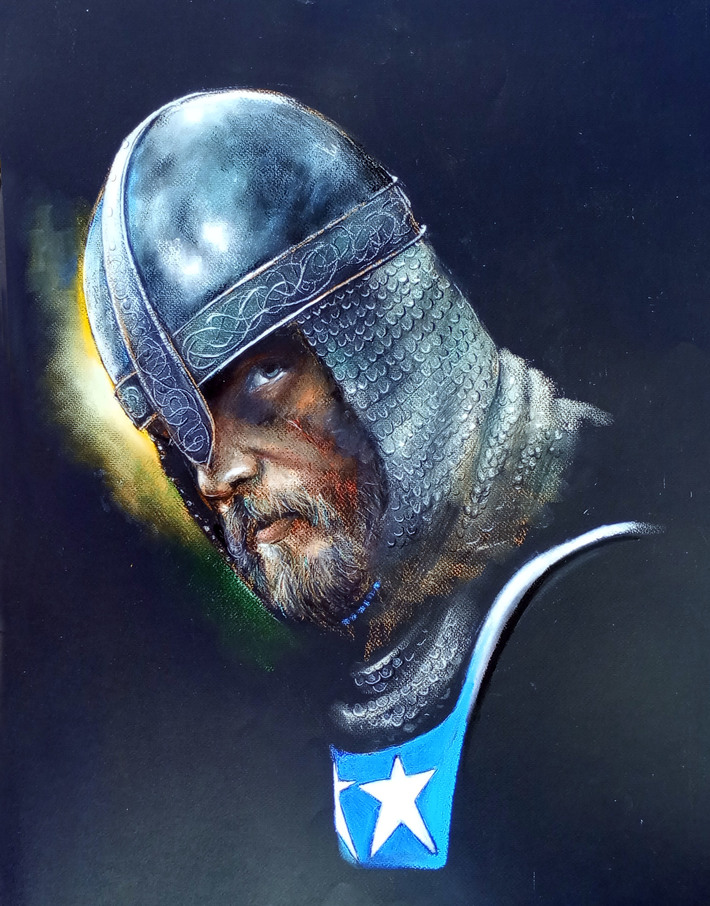
|
| |
Calendar of Documents relating to Scotland;
William ‘le hardi’ Douglas
|
|
|
Events relating to
William ‘le hardi’ Douglas as recorded in the Calendar of Documents relating to Scotland
A narrative interpretation can be found below.
27 January, 1288.
The K. requests the Guardians of Scotland to arrest William de Douglas and Alienora de Ferrars wherever found, and send them before him and his Council to answer for contempt. Westminster.
28 January, 1288.
Writ commanding the Sheriff of Northumberland to seize the lands and chattels of William de Duglas for his contempt in violently abducting and carrying off into the interior of Scotland, Alianora, widow of William de Ferrars, from Elena de Zusche's manor of Tranent, where she was awaiting her dower from the lands of her late husband and to arrest and imprison himself if he can be found. Westminster.
15 May, 1290.
William de Douglas, in prison at Ledes Castle, is released on the mainprize (undertaking given to a Court) of John de Hastings and others that he will stand his trial. Westminster.
24 May, 1290.
The King commands the Sheriff of Northumberland to repledge the lands and goods of William Douglas and his men seized for his abduction of Alianora de Ferrars, till the quinzaine of St Hilary next, when the K. and Council will take order therein. Westminster.
18 February, 1291.
The K. for a fine of 100 I made by William de Douglas, grants him the marriage of Alianora widow of William de Ferrars. Ambresbury.
5 July, 1291.
Sir William Douglas swore fealty in the chapel of Sir Walter de Lindesay's manor, where the K. was then staying.Thurston (Thurstanton).
3 October, 1293.
As William de Douglas was in prison during the last iter (round) of pleas of the forest in Essex, the K. pardons his fine of 20 l for default.Tettebury.
1296 -
William swore fealty twice to the King twice. Once was on 10th June, 1296 in Edinburgh. The other time was on 28th August, 1296 at Berwick.
12 September, 1296.
Writ to the sheriff of Fife to restore his lands to William Douglas. Berwick - on -Tweed.
12 June 1297.
Essex - The sheriff to seize the lands and goods of William de Douglas and his wife. Lenham.
Northumberland. Similar to Douglas's lands there. Lenham.
9 July, 1297.
Robert de Brus earl of Carrick, James the Steward of Scotland, Alexander de Lindseye, John the brother of the Steward, and William de Douglas, confess their rebellion against the K., and place themselves in his will. Irvine.
24 July, 1297.
Sir William de Douglas is in his prison at Berwick castle in irons. Begs he may not be freed till the K. knows the charges against him.
23 October, 1297.
The K. by his Council at Westminster, has committed to Alianora wife of William de Duglas the manor of Wodeham Ferrers, part of her dower from William de Ferrers her former husband (seized for William de Duglas's offences, who is a prisoner in the Tower (of London ), worth 16l . 2s. 6d. yearly, she drawing 10l. yearly for herself and paying 6l. 2s. 6d. at Exchequer.
Afterwards, on 1st May 1298, the K. granted her the manor free of the yearly payment at Exchequer.
Douglas had been committed to the Tower (of London) along with Thomas de Morham and another, under mandate by the Prince of Wales on 12th October.
20 January, 1298.
The K. to John de Langeton his chancellor. As Alienora widow of Sir William de Douglas ' who is with God, ' has begged the K. for her dower lands from Sir William de Ferrers her first husband, which were seized along with the said William de Douglas's other lands, for his rebellion, he commands the said dower lands to be restored to her. Massingham.
24 November, 1298.
The K. commands the sheriff of Northumberland to deliver the manor of Faudon, forfeited by William de Douglas, a Scotsman and rebel, to Gilbert de Umfraville earl of Angus. By the K. himself. Newcastle-on-Tyne.
1 July, 1302.
Petition of Alianora de Ferriers as to rectification of the demand against her for the balance of William de Douglas's fine of 100l. for marrying her, as his own lands of Faudon were sufficient security.
13 January, 1305.
Northumberland - The sheriff ordered to levy from the lands and chattels of the late William de Douglas as on 18th February, the arrears of his fine for marrying Alianora widow of William de Ferrars; and to have the money at Westminster on the morrow of the close of Easter, to be paid to the K. By writ under the Great seal.
19 February, 1305.
Northumberland - The sheriff ordered to levy from the lands and chattels of the late William de Douglas as on 18th February, the arrears of his fine for marrying Alianora widow of William de Ferrars; and to have the money at Westminster on the morrow of the close of Easter, to be paid to the K. By writ under the Great seal.
(Calendar of Documents relating to Scotland - 1272 to 1307. Preserved in Her Majesty’s Public Record Office, London. Edited by Joseph Bain. H. M. General Register House, Edinburgh - 1884).
William ‘le Hardi’ Douglas: Rebel, Romantic, and Reluctant
Royalist
In the turbulent twilight of the 13th century, few
figures stirred the political pot quite like Sir William ‘le Hardi’
Douglas. A man of fierce passions and defiant loyalties, Douglas’s life
reads like a medieval thriller—abduction, rebellion, imprisonment, and
uneasy allegiance to the English crown. His story, stitched together
from royal writs and court records, reveals a complex character
navigating the shifting sands of Anglo-Scottish power.
The
Abduction Scandal
On 27 January 1288, Westminster issued a royal
command: William de Douglas and Alianora de Ferrars were to be arrested
and brought before the King’s Council. The charge?
Contempt—specifically, Douglas’s brazen abduction of Alianora, widow of
William de Ferrars, from Tranent, where she awaited her dower. The next
day, the Sheriff of Northumberland was ordered to seize Douglas’s lands
and goods and imprison him if found. It was a scandal that rocked both
courts and corridors.
Trial, Marriage, and Fealty
After
two years in prison at Leeds Castle, Douglas was released in May 1290
under the mainprize of John de Hastings and others. The King, ever
pragmatic, allowed Douglas to marry Alianora in 1291—for a hefty fine of
£100. That same year, Douglas swore fealty to the King at Thurston, a
gesture of loyalty that would be repeated in 1296 at both Edinburgh and
Berwick.
Yet Douglas’s allegiance was never simple. Pardoned for
a forest fine in 1293, his lands were briefly restored in 1296, only to
be seized again in 1297 amid renewed rebellion.
Rebellion and
Imprisonment
In July 1297, Douglas joined Robert de Brus, James
the Steward, and others in confessing rebellion against the King at
Irvine. Weeks later, he was shackled in irons at Berwick Castle,
pleading not to be released until the charges were clear. By October, he
was transferred to the Tower of London, his lands and reputation in
tatters.
Alianora’s Dower and Douglas’s Decline
Despite
Douglas’s imprisonment, Alianora retained a foothold in English lands.
In 1297, she was granted the manor of Wodeham Ferrers, part of her dower
from her first husband. By 1298, she held it free of Exchequer payments.
After Douglas’s death—recorded by the King in January 1298—Alianora
petitioned for the return of her dower lands and sought relief from the
lingering fines tied to her second husband’s rebellion.
Legacy
and Forfeiture
Douglas’s forfeited manor of Faudon was handed to
Gilbert de Umfraville, Earl of Angus, in 1298. Yet the shadow of his
defiance lingered. As late as 1305, the sheriff of Northumberland was
ordered to extract the remaining balance of Douglas’s marriage fine from
his estate.
William ‘le Hardi’ Douglas remains a figure of
contradiction: a knight who defied royal authority, abducted a noble
widow, swore fealty with one hand and rebelled with the other. His life,
preserved in the dry ink of royal records, pulses with drama, daring,
and the enduring tension between love and loyalty.
See also:
•
William le hardi Douglas, main article
• Timelines
Contributions:
I am grateful to
Sally Douglas for her
assistance with this article.
Do you have an ancestor whose
story should be told here? Can you add to this article? Please let us have the details.
|
Source
Sources for this article include:
Calendar of Documents relating to Scotland - 1272 to 1307. Preserved in
Her Majesty’s Public Record Office, London. Edited by Joseph Bain. H. M. General
Register House, Edinburgh - 1884
Any contributions will be
gratefully accepted
|
|