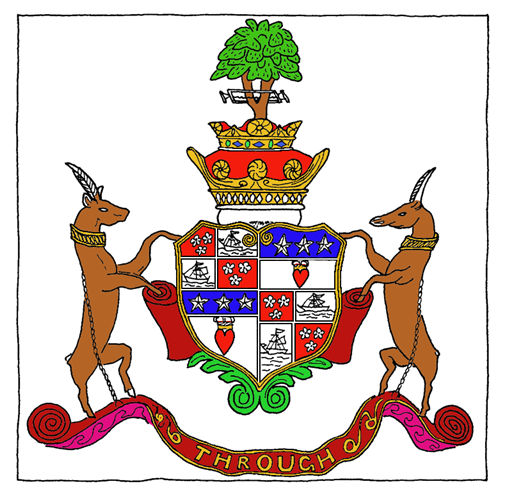
The coat of arms of Duke William and
Duchess Anne of Hamilton
reflects the powerful lineage and historical significance of the House
of Hamilton and Douglas.
- First and fourth quarters: Gules, three
cinquefoils ermine, representing Hamilton.
- Second and third
quarters: Argent, a ship with sails furled, sable, symbolizing Arran.
- Second ground quarter: Argent, a man's heart gules, ensigned with an
imperial crown or; on a chief azure, three stars of the first,
signifying Douglas.
- Third ground quarter: Identical to the second.
- Fourth ground quarter: Identical to the first.
The arms are
supported by two antelopes, traditionally argent but depicted proper to
stand out against the background. They are armed and unguled, their
hooves contrasting in tincture, and they are ducally gorged and chained
or. Above the escutcheon, a large ducal coronet represents the Duchess,
surmounted by a smaller one for the Duke. The crest features an oak
tree, its main stem penetrated transversely by a frame saw proper, with
the frame or—an emblem of the House of Hamilton. The Douglas equivalent,
a salamander in flames, is absent. Below, the motto “THROUGH” is
inscribed on a ribbon.
Anne Hamilton held the title of Duchess of Hamilton in her own right
following the execution of her father and later the death of her uncle
at the Battle of Worcester in 1651. Her subsidiary titles included
Marchioness of Clydesdale; Countess of Arran, Lanark, and Cambridge; and
Lady of Aven, Innerdale, Machanshire, and Polmont. Her husband,
William Douglas, 1st Earl of
Selkirk, was granted the title Duke of Hamilton in 1660 for his
lifetime, which ended in 1694. In heraldic terms, Duchess Anne holds
precedence on the coat of arms, not only by virtue of her titles but
also because Kinneil remained a Hamilton possession.
Beyond
heraldry, Duchess Anne played a crucial role in the development of
Borrowstounness (Bo’ness). In 1668, thanks to her influence, the town
became a burgh of regality—an essential step towards local governance. A
year later, Bo’ness was granted free port and harbour status, cementing
its importance in regional trade.
Historian TJ Salmon recognized
her contributions, writing in 1913:
"To Duchess Anne and Duke
William, her husband, much credit is due to the early development of the
village of Borrowstounness. With them commenced a thoroughly practical
interest in the struggling town and in their own House of Kinneil."
Their impact extended to Kinneil Estate, where the couple undertook
significant renovations, expanding and embellishing Kinneil House into a
notable residence. Duchess Anne oversaw the creation of workers'
cottages on the estate and a neighbouring stable block, now home to
Kinneil Museum. Her dedication to the estate and town earned her the
affectionate title The Good Duchess.
Heraldic tradition and civic
development intertwine in Duchess Anne’s legacy, ensuring that both her
arms and actions continue to shape Scottish heritage.
Contributions
Do you have an ancestor whose
story should be told here? Please let us have the details.
Source
Sources for this article include:
G.B. Bailey; Falkirk Local History Society |