This page is a stub.
You can help improve it.
Harry Robert Douglas was a Scottish portrait painter born in
Edinburgh in 1862. He studied under the renowned artist Sir Noel Paton
(1821–1901), whose influence shaped Douglas’s meticulous approach to
portraiture. In the mid-1880s, Douglas relocated to Belfast, where he
established himself as a professional portrait painter and became an
active figure in the city’s artistic circles.
By 1888, Douglas was a member of the Belfast Ramblers' Sketching Club
and served on the committee of the Belfast Art Society. His involvement
deepened over time, and by 1901 he held the position of honorary
secretary of the Society, contributing to the development of Belfast’s
cultural life.
Though not a prolific exhibitor, Douglas’s work was occasionally
shown at prestigious venues such as the Royal Hibernian Academy and the
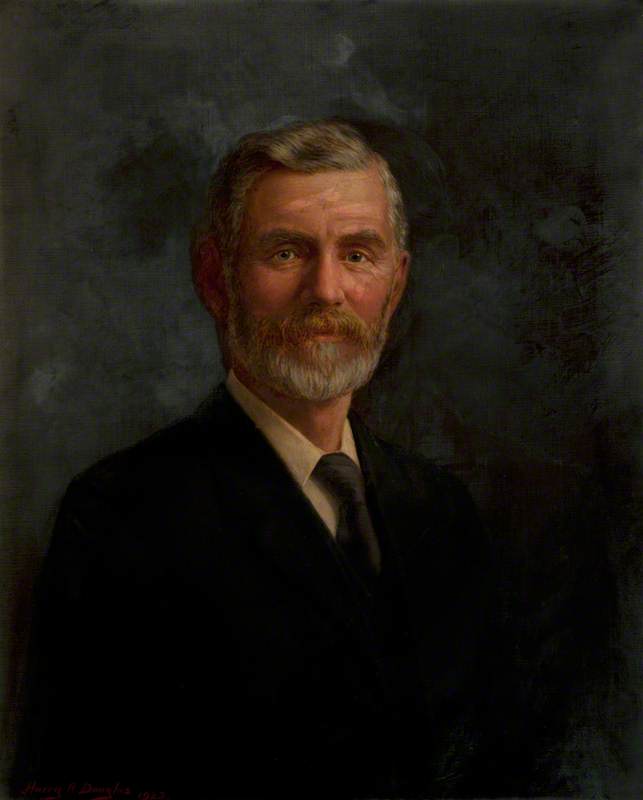
Walker Art Gallery in Liverpool. One of his most notable portraits—of
civic dignitary and philanthropist Sir Robert Meyer (1879–1985)—was
exhibited at the Ulster Museum in 1927 and now resides in the collection
of Belfast City Hall. Additional works by Douglas are held by the Ulster
Museum and Art Gallery, as well as the Medical Department of Queen’s
University Belfast.
Douglas’s style was noted for its photographic fidelity. As the
Dublin Art Monthly remarked in 1927, “The fidelity of his painting,
albeit that it is a photographic fidelity, every vein and bone stands
out clearly defined.” This precision, while sometimes critiqued for its
literalness, reflected his commitment to anatomical accuracy and formal
portraiture.
Beyond painting, Douglas had a keen interest in travel and
contributed to regional tourism literature. He authored the Ulster
Tourist Development Association Guide to Sport in Ulster,
showcasing his broader engagement with the cultural life of the
province.
Harry Robert Douglas died in 1934, with his death recorded at the
Belfast Mental Hospital.
His legacy endures through the portraits that continue to grace
public institutions and reflect the civic and cultural character of
early 20th-century Ulster.
|