|
| |
Sir George Douglas of Pittendreich
 |
 |
George Douglas of Pittendreich (d. 1552): Summary
George Douglas of Pittendreich was a prominent member of the powerful Red Douglas family and the younger brother of Archibald Douglas, 6th Earl of Angus. He played a critical role in Scottish politics during the minority of
James V and later, Mary, Queen of Scots.
Family and Dynastic Power
* George's parents were George Douglas, Master of Angus, and Elizabeth Drummond. He was married to Elizabeth Douglas of Pittendreich.
* He used his influence to advance his family's position:
* His second son, James, was married to Elizabeth Douglas, the youngest daughter of the 3rd Earl of Morton, which ultimately led to James inheriting the title and becoming the 4th Earl of Morton and Regent of Scotland.
* His eldest son, David, became the 7th Earl of Angus.
* His illegitimate son, George Douglas of Parkhead, became Provost of Edinburgh and Keeper of Edinburgh Castle.
Struggle for Control of James V
* The Douglas family held custody of the young James V starting in 1526. George was tasked with keeping a secure watch over the King.
* In May 1528, James V successfully escaped from George's custody at Falkland Palace.
* Subsequently, the family was forfeited by the Scottish Parliament and went into exile in England, despite their stronghold, Tantallon Castle, successfully resisting the King's siege.
Peacemaking, Intrigue, and the English Alliance (1543-1544)
* After James V's death and the Battle of Solway Moss, George and his brother returned to Scotland in January 1543, where they were restored to their lands.
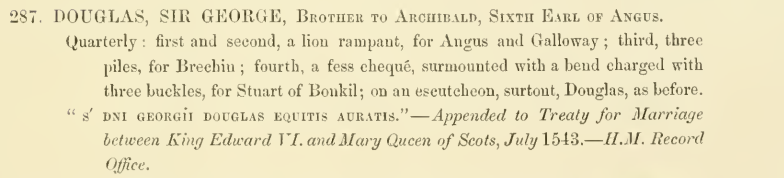
* Initially, George was a key proponent of the "English marriage" (Mary, Queen of Scots to Prince Edward of England), working with the English diplomat Ralph Sadler. He was a Scottish commissioner who completed the Treaty of Greenwich in July 1543, which outlined the marriage and peace terms.
* He attempted to reconcile Regent Arran with Cardinal Beaton, who opposed the marriage, preventing immediate armed conflict.
* After the Scottish Parliament rejected the Treaty of Greenwich in December 1543, leading to the Rough Wooing war, George strategically shifted his loyalty.
Supporting Mary of Guise and Final Years
* George became a supporter of Mary of Guise (Mary, Queen of Scots' mother) against Regent Arran, receiving a pension from her and offering advice on foreign policy.
* In February 1545, he advised Henry VIII to adopt a gentler approach to win Scottish favor, arguing that the extreme cruelty of the war was turning the people against England.
* In 1548, he was appointed Captain of Dalkeith for the English but then sided with the Regent. He narrowly escaped capture by English forces at Dalkeith Palace, though his son James was captured and injured.
* George Douglas died in the north of Scotland in 1552, while in the service of Mary of Guise.
Notes
and research comment:
Father: George
(Master of Angus) Douglas b: ABT. 1469
Mother: Elizabeth
Drummond
Marriage 1 Elizabeth
Douglas, daughter and heiress of David Douglas
Children
- James
Douglas married Elizabeth, dau of James,
3rd Earl of Morton. Their son, James,
inherited the Earldom.
- David
Douglas, 7th Earl of Angus b: ABT. 1515
He also had a natural son, George
Douglas of Parkhead. He acquired the estate of Pittendriech through his
wife. Sir George Douglas of Pittendreich was master of the royal household,
and in September 1526, had the charge of the young king, when his brother
hastened forward from Edinburgh, to encounter the force under the earl of Lennox
at Linlithgow bridge, on that nobleman’s unsuccessful attempt to rescue the
monarch from the Douglases. James, who secretly favoured Lennox’s enterprise,
advanced slowly and unwillingly, when Douglas, incensed at the delay, seizing
his horse’s bridle, passionately exclaimed, “Think not that in any event you
shall escape us; for even were our enemies to gain the day, rather than
surrender your person, we should tear you in pieces,” – a threat which was never
forgiven by the king. He was forfeited, along with his brother and uncle, 5th
September 1528, when he took refuge in England. In 1542, he and the earl his
brother, at the head of a large body of their retainers, joined an English force
which made a hostile incursion across the borders into Scotland, but was
defeated at Hadden-rig by the earl of Huntley and Lord Home.
After the
death of James the fifth, the forfeiture of the Douglases was rescinded by
parliament, 15th March 1542-3, and Sir George, on his return to Scotland, was
appointed a member of the privy council of the regent Arran. He had been
entrusted by Henry the Eighth with the principal share in negotiating the
proposed marriage of the young queen Mary with Henry’s son, Prince Edward, and
made several journeys into England on that account in 1543. His talents, says
Tytler, for the management of political affairs were superior to those of his
brother, the earl, over whose mind he possessed great influence, and in his
correspondence with Henry he expresses himself with great warmth of devotion to
the English monarch, who, in his designs upon Scotland was very much guided by
the information transmitted to him and his ministers by Sir George.
The
treaties of peace and marriage were finally arranged at
Greenwich on the 1st
July 1543. In all the intrigues of the period he acted a prominent part, and
when Angus and the other lords of the English faction, to escape the sentence of
forfeiture to which their repeated treasons had exposed them, transmitted to the
governor Arran a bond of adherence to the government, Sir George was one of the
pledges that it would be faithfully kept, but was soon liberated. He and his
brother subsequently joined the party of Cardinal Bethune, and their names
appear among those of the Scots nobility who signed the agreement in June 1544,
to support the authority of the queen-mother as regent of Scotland against the
earl of Arran. In a parliament held at Edinburgh in the beginning of December of
the same year, he and the earl were absolved from the charge of treason, and
declared innocent of the crimes which had been alleged against them. In 1545 he
joined the earl of Cassillis and other noblemen in the conspiracy (mentioned by
Mr. Tytler for the first time by any historian) which, on the suggestion of
Henry the Eighth, they had entered into for the assassination of Cardinal
Bethune, and had an interview with one Thomas Forster, the English envoy, on the
subject, but the project seems early to have been abandoned on their part. In
August 1545, he was with the Scots army that invaded England, the vanguard of
which was commanded by the earl of Angus, but retreated without effecting
anything of consequence, “through the deceit,” as an ancient Chronicle relates,
“of George Douglas and the vanguard.”
In the memorable year 1546, after
hearing George Wishart preach at Inveresk, he said publicly, “I know that my
lord governor and my lord cardinal will hear that I have been at this sermon.
Say unto them, I will avow it; and not only maintain the doctrine that I have
heard, but also the person that teacheth, to the uttermost of my power.” After
the assassination of Cardinal Bethune, he and his brother the earl of Angus were
the first to vote that the castle of St. Andrews, in which those engaged in that
act had taken refuge, should be besieged. He is said by Douglas in his Peerage
to have been killed at the battle of Pinkie, 10th September 1547, but there is
no evidence for this statement; and Godscroft says expressly that having been
one of the “appointed to ride about among the soldiers, to encourage them and
keep order, it was so much the easier for him to flee.”
He appears as one of the extraordinary lords of session in the sitting of
that court of the 1st April 1549. He died before his brother, though the date of
his death is not mentioned by the family historian.
By his wife,
Elizabeth, daughter and heiress of David Douglas of Pittendreich, he had
David,
seventh earl of Angus, James, earl of Morton, regent of Scotland, and two daughters. George
also had a son, George, and two daughters, Elizabeth and Margaret, outside his marriage. The son married Marioun Douglas heiress of Parkhead or Parkheid, and so became known as George Douglas of
Parkhead and was later Provost of Edinburgh and keeper of Edinburgh Castle. His daughter by Lady Dundas, Elizabeth, married Smeton Richeson. Margaret Douglas, who was born in Berwick, married a son of John Selby of Branxton Although he appears to be alive in
1549, some have him as killed at the Battle
of Pinkie, 1547, as above.
See also:
• Douglas of Pittendreich family tree [ pdf]
• Douglas family of
Pittendreich |