This page is a stub.
Coat of Arms: Erm. on a
chief az. three stars ar. a bordure gu.
Crest: A hand holding a
man's heart ppr. ensigned with a crescent ar.
Motto: Meliora
sperando.
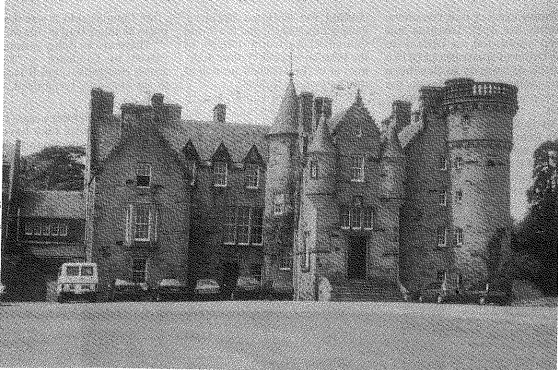
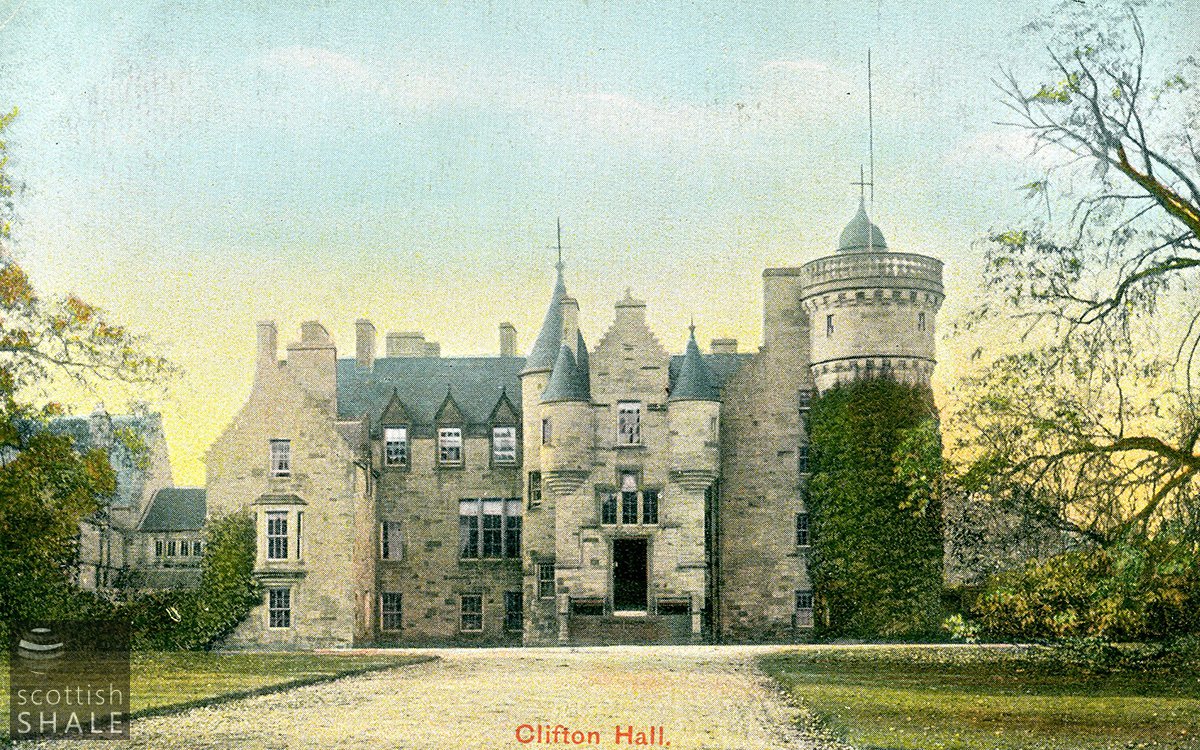
Cliftonhall - an extract of history:
Clifton
Hall dates back to 1165, but the Douglas interest dates from about 1600.
Clifton
Hall is a mansion used as a school, located two miles east of Broxburn,
in West Lothian.. The mansion replaced a castle, or old house.
In
the 16th Century, we find that the owner of Clifton Hall was Thomas Macalzean. On
June 10th 1556, by command of the Queen Regent, he was deprived of his
office by the Assessor by the Town Council of Edinburgh, for “evil,
heich and unpleasant language to her Grace,” in the discharge of his
official duties. The Assessor protested against this decree and after a
lapse of a few months was restored by the Queen Regent.
On
October 8th 1561, Thomas Macalzean was elected Provost of Edinburgh. A
cordial supporter of the Reformation, he was one of those appointed by
the General Assembly to decide questions and revise sentences. On
October 1570, he was appointed Lord of Session in the room of Henry
Balnavis, deceased, and took the title of Lord Clifton Hall. He died
about 1581 leaving an only daughter and heiress, Euphame.
Euphame
Macalzean was the most celebrated of all Scottish witches. After a long
and notorious career she was tried by the High Court of Justiciary for
numerous crimes ranging from common witchcraft to a conspiracy against
the life of the King. She was sentenced to death by burning and paid the
full penalty on the Castle Hill of Edinburgh on 25th June 1691. Euphame
is the only Scottish witch on record to have been burned alive. Other
offenders were always strangled by the common hangman before being
burned at the stake. Her lands and goods were forfeited, but her
children were restored on giving up the lands to the King’s favourite,
Sandelands of Slamannan; but as no male heirs existed little benefit
could be reaped by the successors, and the title of Clifton Hall became
extinct.
A century later, the estate belonged to a family named
Douglas. Archibald Douglas was a persecutor of the Covenanters and rode
in the troop of the Laird of Hatton (a nearby estate, the mansion house
of which was partly destroyed by fire in 1952). Both these gentlemen
were under the celebrated General Tam Dalyell of the Binns, who routed
the Covenanting Army at Pentland and who raised the regiment known as
the Scots Greys.
In 1703, the estate was purchased by George Wishart, son of the Rev.
William Wishart, minister at Kinneil. He served in Carmichael’s Regiment
of Dragoon Guards, with the rank of Lieutenant Colonel and in 1706 was
created baronet by Queen Anne.
Douglas of Cliftonhall — A Multi‑Generation Archival Lineage
In the closing years of the sixteenth century, the
line of Douglas of Cliftonhall emerged from the old West Lothian
branches of Knightsridge and Pumpherston. At its head stood Mr. William
Douglas, eldest son of James Douglas of Knightsridge and grandson of
Robert Douglas of Pumpherston, whose steady accumulation of land and
legal standing laid the foundation for the family’s later prominence. In
1586, William and his mother, Margaret Douglas, secured the lands of
Canylands through a formal resignation by Robert Linton, Advocate—an
early sign of the family’s rising influence. William was served heir to
his father in portions of Rathobyres in 1597, and, having been admitted
an Advocate, extended his holdings with the acquisition of Cliftonhall
in Midlothian, establishing the estate that would define the family’s
identity for generations. His life, marked by two marriages - first to
Elizabeth Sinclair, widow of Andrew Howburne, and later to Elizabeth
Douglas - produced the heirs who would carry the Cliftonhall name
forward. William’s death in March 1639 closed the first chapter of the
Cliftonhall story, leaving a legacy rooted in land, law, and the quiet
consolidation of Douglas heritage on the outskirts of Edinburgh.
I. William Douglas, 1st of Cliftonhall (d. 1639)
The Cliftonhall line begins with Mr. William Douglas,
eldest son of James Douglas of
Knightsridge and grandson of
Robert Douglas of Pumpherston,
whose careful stewardship of land and legal standing shaped the family’s
rise. In 1586, William and his mother
Margaret Douglas secured
Canylands, and in 1597
he was served heir to portions of
Rathobyres. His admission as an Advocate and subsequent
acquisition of Cliftonhall
established the estate that would define the family’s identity. His
first marriage to Elizabeth
Sinclair produced a son, James (1609–1613). His second marriage
to Elizabeth Douglas
brought three further children:
James, William,
and Elizabeth. William’s
death in March 1639 closed the founding chapter of the Cliftonhall
story.
II. James Douglas, 2nd of Cliftonhall (bap. 1624)
Baptised in Edinburgh on 25
November 1624, James Douglas
succeeded his father while still a minor. His tenure marked the
consolidation of the estate rather than expansion, reflecting the
quieter rhythms of a landed Midlothian family in the mid‑seventeenth
century. James married Violet —
a union that continued the line into a more settled era, though the
surviving records of his administration are sparse. His stewardship
bridged the turbulent decades surrounding the Covenanting period,
preserving Cliftonhall through a time when many lesser estates
fractured.
III. The Third Generation — Continuity in a Changing
Scotland
The next generation of
Cliftonhall Douglases, descending from James and Violet, carried the
estate into the later seventeenth century. Though the documentary trail
grows thinner, the family maintained its status among the minor gentry
of Midlothian, holding Cliftonhall through the Restoration and the
Revolution of 1688. Their presence in parish registers and sasine rolls
reflects a lineage that remained steady, respectable, and locally rooted
— a contrast to the more dramatic fortunes of their cousins in the
greater Douglas houses.
IV. The Fourth Generation — Cliftonhall in the Early
Eighteenth Century
By the early eighteenth century,
the Douglas family of Cliftonhall had become a fixture of the region’s
landed landscape. Successive lairds oversaw the estate during a period
of agricultural improvement, enclosure, and the gradual reshaping of
rural society. While not prominent in national politics, the Cliftonhall
Douglases appear in legal instruments, property transactions, and
kirk‑session records, marking them as a stable and enduring branch of
the wider Douglas kinship network.
V. Later Generations — Decline, Dispersion, and Legacy
As the eighteenth century
progressed, the Cliftonhall line began to disperse. Younger sons entered
the professions, the military, or the church, while daughters married
into neighbouring families. The estate itself eventually passed out of
Douglas hands, part of the broader pattern of consolidation among larger
landowners. Yet the Cliftonhall Douglases left a distinct imprint: a
lineage built not on dramatic feudal power but on the quieter virtues of
stewardship, legal learning, and local standing. Their story forms a
modest but meaningful thread in the tapestry of Douglas history.
Archival Note
This lineage reflects the
surviving genealogical and legal records of the Cliftonhall branch,
whose documentation is less abundant than that of the principal Douglas
houses. Where the sources thin, the narrative follows the established
patterns of Scottish landed families of similar rank and period,
preserving the continuity of the Cliftonhall story while respecting the
limits of the historical record.
Research notes:
• The 1639
will of Wm DOUGLAS, of Cliftonhall refers to James WASON as sister’s
son. ?Watson of Saughton. James Watson, portioner of Saughton in
1623, mother is said to be Anna Douglas.
• Archibald Douglas rode
with General Tam Dalyell of the Binns in the Scots Greys.
• Douglas,
William, of Cliftonhall and Knightsrig, 21 Feb. 1600 died ...
• The laird of
Pumpherstoun is included in a list of gentlemen of the name of
Douglas who bear evil will against Andro, Lord Stewart of Uchiltrie,
on account of the slaughter of James, Lord Torthorwald ; and the
Privy Council being determined that "all unlauchfull revenge so
dishonourable to the natioun and offensive to his Heynes salbe
forborne," Pumpherston and Uchiltree are required to enter into
reciprocal assurances in ;^iooo to keep the peace towards each
other, 2nd March 1609. Joseph Douglas of Pumpherston was on an
assize 20th December 1616, and in 1636 he witnesses the baptism of
his grand-daughter Margaret Douglas. His latter will is dated at
Cliftounhall 23rd April 1637, and he died within the same year. He
had a son, William, who succeeded him ; another son, Mr Hew, who
witnesses a deed at Cliftounhall 31st January 1623 ; a daughter,
Jean, married to Mr Robert Dalgleish of Lauriston, solicitor to
Charles H, whose only child, Margaret, married in 1662 to Ludovick
Craig of Riccarton ; and a second daughter, Margaret, who married
(contract dated 12th October 1626) George Ker, burgess of Edinburgh.
• Archibald Douglas of Cliftonhall is listed as a
Covenanter in about 1650.
• From 'A history of the Society of Writers to Her Majesty's Signet'
: FRASER, SIMON, of Ford. 19th December 1767. Apprentice to, and eldest
son of, William Fraser of Ford, W.S. — Died 25th September 1819. Mar. 2d
March 1784, Janet Cruickshank, daughter of Captain Charles Douglas of
Cliftonhall, Philadelphia. (Elsewhere 2nd daughter and Cliftonhall, near
Philadelphia) Presumably Philadelphia, USA. The American property was so
named by Capt. John Wilcocks in 1749 when he acquired it from Henry
Lewis III. In 1761, he sold Cliftonhall to Charles Cruikshank.
• Jean Cruikshank, daughter of Charles Douglas of Cliftonhall,
married Simon Fraser of Ford on 9 July 1794
•
Margaret DOUGLAS, (daughter of George Douglas born 26/4/1802, Hownam,
Roxburghshire, and Elspeth Bogue born 21/3/1802) born 26 July 1844
Clifton Hall, Midlothian, Scotland married Joseph FORBES 14 May 1866 at
Maryborough, Queensland, Australia and died 11 November 1916 buried at
Tiaro, Queensland, Australia. Joseph died 4 October 1917 buried at Tiaro.
Joseph listed his occupation as farmer and residence as ”Laburnum Bank”
They had 7 children.
Sources
• Sources for this article include CDAA newsletter No42
•
History of Cliftonhall School
|