This page is a stub.
You can help improve it.
The Douglases of Auchenshinnoch: A Short History of a Galloway Holding
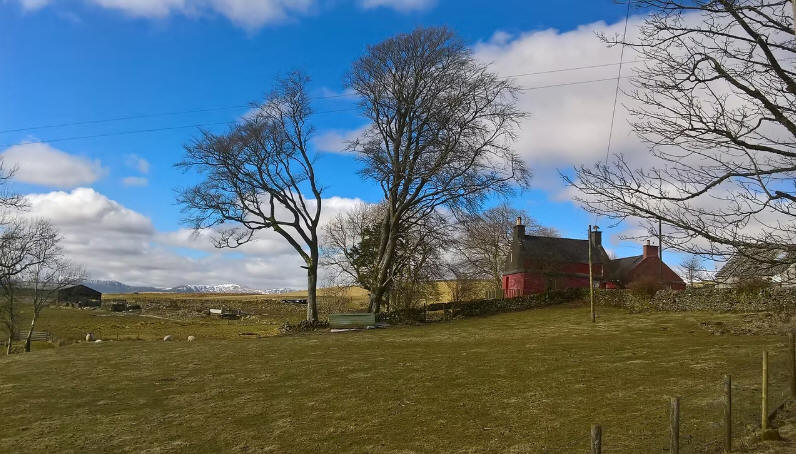
Auchenshinnoch (variously spelled Auchenshinnoch, Auchinshinnock,
Auchinshinnach) was a small agricultural holding in the parish of Dalry,
Kirkcudbrightshire, lying close to the lands of Fingland, Morton, and
Auchenshinnoch Hill. It appears frequently in seventeenth and eighteenth
century sasines, usually in connection with minor lairds or cadet
branches of larger families.
It was not a major estate - more a
working farm with grazing rights, typical of the upland fringe of
Galloway - but it sat within a cluster of Douglas held properties. The
small Galloway property of Auchinshinnoch, lying close to Fingland and
Morton, passed through several branches of the Douglas family during the
seventeenth and early eighteenth centuries. Though modest in scale, its
ownership offers a revealing glimpse into the shifting patterns of
landholding among the lesser lairds of Nithsdale and Galloway.
The earliest clear reference comes from June 1670, when the estate
passed to Samuel Douglas, brother of William Douglas of Morton,as
recorded by both McKerlie in Lands and their Owners in Galloway and
Ramage in Drumlanrig Castle and the Douglases. This transfer places
Auchinshinnoch firmly within the orbit of the Morton Douglases, a cadet
line long associated with the district.
By 1682, ownership had
consolidated further. Contemporary records note that James Douglas of
Morton then held both Fingland and Auchinshinnoch, suggesting a period
of reunification of the neighbouring lands under a single proprietor.
Whether this represented a purchase, inheritance, or internal family
arrangement is not stated, but it reflects the fluidity with which such
smaller estates often moved within extended kin networks.
A
generation later, the property again changed hands. On 10 December 1709,
Robert Douglas, second son of Archibald Douglas of Fingland (born 1633),
received sasine of Auchinshinnoch. His tenure, however, was remarkably
brief. Only four days afterwards, sasine was granted to Margaret Corbet,
eldest daughter of James Corbet, a Glasgow merchant. The proximity of
the two transactions strongly suggests that Margaret was Robert’s wife
and that the land was being settled upon her - either as part of a
marriage contract or as security for a financial arrangement.
By
1717, Auchinshinnoch had passed out of Douglas hands entirely. It was
then held by James Davies of Leonard Coast in Cumberland, marking the
end of nearly half a century of intermittent Douglas possession.
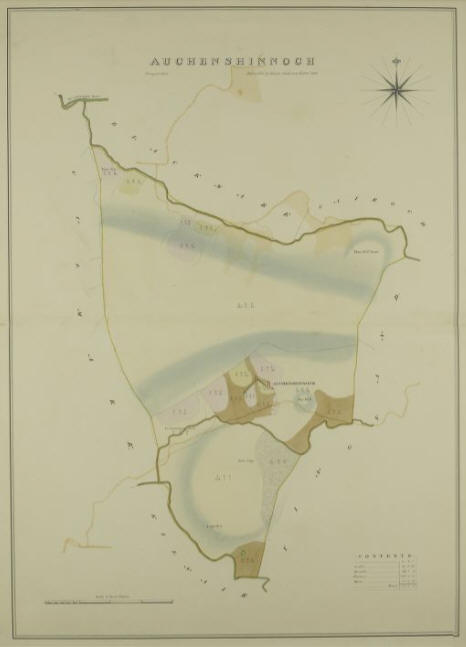
Auchenshinnoch was part of the estates was owned by William Forbes of Callendar (1756-1823) and of William Forbes Esq. of Callendar, 1800-1817.
The map is dated 1816.
Though small, Auchinshinnoch's history illustrates the intricate web
of family ties, marriage alliances, and economic pressures that shaped
landholding in early modern Galloway. Its passage between the Douglases
of Morton and Fingland, and finally to an English proprietor, reflects
the broader story of a region where lineage, opportunity, and
circumstance were constantly in negotiation.
Below is
an interesting document, courtesy of the Auchenshinnoch website, from the
year 1646 that mentions Auchenshinnoch, interestingly many of the other
farms (lands) named still exist today.
Charles I: Translation
1645, 26 November, St Andrews, Parliament
Parliamentary Register
2
February 1646
Act in favour of Sir James Lockhart, Laird of Lee
|
The estates of parliament, having heard and considered the supplication of Sir James Lockhart of Lee desiring warrant from the parliament to the commissary of the treasury, treasurer depute and commissioners of exchequer to receive and pass his signature upon his comprising and disposition of the lands of Blackmark, Carrock, Orley, Cornharrow, Craiglowrie, Auchenshinnoch, Fingland, Troston, Knocksting and Lochrennie, extending to a 8 merk 6s 8d land as a part of the fifteen merk land of the barony of Gordonston, lying within the parish of [...] and sheriffdom of [...], held by [Robert Gordon], viscount of Kenmure and his predecessors (from whom the same was comprised) blench of Robert [Maxwell], sometime earl of Nithsdale, who held the same of the king's majesty, to the effect the supplicant may thereupon get infeftment of the same lands to be held of the king's majesty in the same form and manner of blench held as the viscount of Kenmure, his author, held the same of the late earl of Nithsdale, as the supplication more fully bears. The said estates of parliament do hereby give warrant to the commissioner of the treasury, treasurer depute and commissioners of exchequer and by this act ordain them to receive and pass the supplicant's signature of the aforesaid 8 merk 6s 8d land above-mentioned lying as said is upon his aforesaid comprising and disposition thereof for infeftment to be given to him of the same to be held of the king's majesty in the same form and manner of blench held as the viscount of Kenmure, his author, held the same of the late earl of Nithsdale or his predecessors, and in respect hereof ordain the said Sir James Lockhart of Lee, supplicant, to give satisfaction to the creditors of the late earl of Nithsdale at the sight of the committee of estates, according to the act of parliament made relating thereto.
|
Note:
• Auchinshinnoch comes from the gaelic, meaning
the field with the spring of water at the hill, or hillock.
See
also:
• Douglas of Fingland
Source
Sources for this article include:
Auchenshinnoch websiteMcKerlie; Lands and their Owners in GallowayRamage;Drumlanrig Castle and the DouglasesDumfries Archival Mapping Project
Contributions
Do you have an ancestor whose
story should be told here? Can you add to this article?
Please let us have the details.
|