|
| |
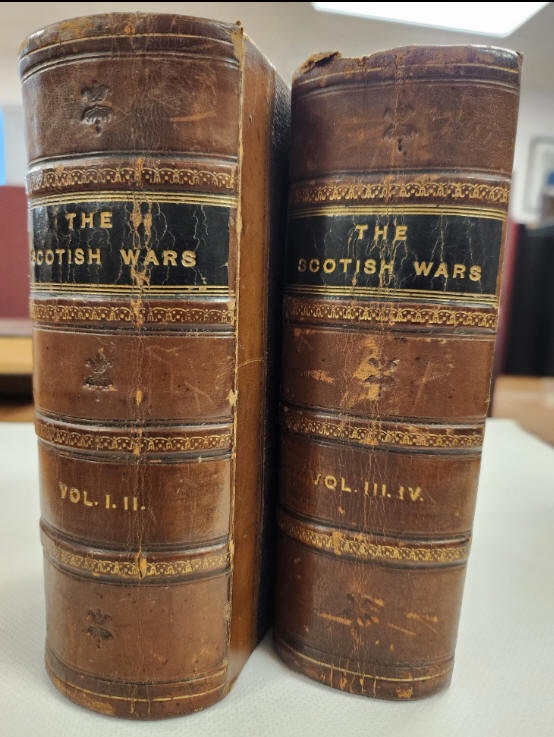
Historical Tales of the Wars of Scotland and of the Border Raids,
Forays and Conflicts
|
|
|
This page contains links, below to extracts from Historical Tales of the Wars of Scotland and of the Border Raids, Forays and Conflicts;
Author: John Parker Lawson
A Narrative on the Origins and Nature of Lawson’s Historical
Tales
In the year 1839, at the height of Britain’s Romantic fascination with its own past, the Glasgow and Edinburgh firm of Fullarton & Co. published a handsome multi‑volume anthology under the title Historical Tales of the Wars of Scotland and of the Border Raids, Forays and Conflicts. Its author, John Parker Lawson, was one of those industrious Victorian compilers who sought to make the nation’s history vivid, accessible, and morally instructive for a broad reading public.
Lawson was not a medievalist, nor a scholar of original charters and manuscripts. He was a storyteller of the Victorian school — a man who believed that Scotland’s past should be retold in a manner that stirred the imagination, ennobled the heart, and reinforced the patriotic sentiment that was then sweeping the country. His Historical Tales were therefore not primary documents, but retellings: polished, dramatic, and shaped to suit the tastes of the 1830s and 1840s.
To craft these narratives, Lawson drew deeply from the great chroniclers of earlier centuries. David Hume of Godscroft, whose History of the Houses of Douglas and Angus (1644) remained the foundational text for all Douglas lore, provided him with the bones of many stories — the Palm Sunday ambush, the Douglas Larder, the feuds of the Black Douglases, and the long struggle with the Crown. John Barbour, the fourteenth-century
archdeacon whose Brus preserved the earliest poetic memory of the Wars of Independence, supplied the heroic tone and the moral gravity that Victorian writers admired. And from Sir Walter Scott, especially the late novel Castle Dangerous (1831), Lawson absorbed the Romantic colour, the atmospheric ruin, and the sense of Scotland as a land where history and legend were inseparably entwined.
Around these sources he wove the Border traditions — the oral tales, the local recollections, the half‑remembered ballads — that had circulated for centuries in the valleys of the Tweed, the Nith, and the Annan. Lawson’s method was to smooth, dramatise, and moralise: to take the rough, contradictory material of earlier ages and present it in a clear, flowing narrative that a Victorian household could read aloud by the fire.
His work is therefore not medieval history, nor even early‑modern historiography. It is a secondary Victorian narrative, shaped by the tastes and assumptions of its age: patriotic, sentimental, morally earnest, and deeply invested in the idea of Scotland as a nation forged by noble suffering and heroic resistance.
Yet for all its embellishment, Lawson’s anthology remains valuable. It
preserves the nineteenth-century imagination of the Douglas story — how Victorians understood the Good Sir James, the Black Douglases, the feuds, the betrayals, and the tragedies. It shows how the Douglas name was woven into the Romantic revival of Scottish identity, and how the great chroniclers of earlier centuries were reinterpreted for a new audience.
In the Douglas Archives, Lawson’s Historical Tales belongs firmly among the Victorian retellings: not as a source for medieval fact, but as a witness to how the Douglas legend was shaped, polished, and transmitted into the modern age.
Extracts from the publication contained in the Douglas Archives:
Assassination of the Earl of Douglas in 1452
The Character and Death of the 6th Earl of Douglas
Battle of Poitiers; The Escape of Douglas
The Execution
of Lady Jane Douglas
The Exploits of
The Good Sir james
Contributions
The Douglas Archives are built
from families histories. Do you have an ancestor whose
story should be told here? Please let us have the details.
|
Source
Sources for this article include:
XXX.
Any contributions will be
gratefully accepted
|
|