|
This contributed article forms part of the
Douglas
of Cavers collection
Cavers was an entailed estate, which under Scots
Law meant ownership of land remained within a specific family line,
restricting the ability of the current owner to sell or bequeath the
property outside of designated heirs. It was a way to keep land intact
and in the family for generations, preventing its sale or transfer to
unrelated individuals. This was amended, first by the Entail Amendment
(Scotland) Act of 1848 which allowed male application to the courts to
disentail. The Married Women's Property Act 1870 allowed married women
to inherit property, but it didn't specifically address entailed
estates, which was resolved by The Married Women's Property (Scotland)
Act 1881. The Entail (Scotland) act of 1882 then brought the gender
issue into line.
According to records held by the National
Library of Scotland, Cavers Estate was first disentailed in 1880
following a petition and application by Mrs. Mary Douglas Malcolm Palmer
Douglas, no doubt following the birth of her son Archibald. This process
involved a decree and other related papers, and as it just preceded what
would have been helpful legislation for her, it must have been something
of a legal battle to secure a successful outcome. Further disentailment
without impairment of other parts of the estate also occurred in 1896,
1924 and 1925; the latter two following the birth of her grandchildren.
Evidence has been found of Roman camps at
Cavers Mains and nearby Eastcote, as well as a cluster of four or five
prehistoric hill-forts, remains near Ormiston of Cocklaw Castle, and, in
the southern division, about 3 miles of the Catrail; whilst a crag
towards the summit of Rubers Law is pointed out as 'Peden's Pulpit'. It
is therefore clear that it was an area of habitation long before Balliol
occupancy.
The first known member of the Balliol family to
be associated with Cavers was Henry de Balliol, but the question has
always been how Henry acquired it. Henry was the son of Ingelram de
Balliol of Barnard Castle, whilst his mother Agnes was daughter and
heiress of Sir Walter de Berkeley, Lord of Redcastle who was Chamberlain
of Scotland under William the Lion in 1165. William (de Berkeley) was
succeeded in this high office by Philip de Valognes, followed by his son
William de Valognes, both Lords of Panmure. The latter died in 1219,
leaving only daughters, one of whom was Lauretta "Lora" de Valognes. She
became Henry’s wife in 1233, thereby obtaining the Chamberlainship which
had been held by the father of his mother, and also by his wife’s father
and grandfather.
Chamberlains were by custom rewarded with
parcels of land for their loyalty and service to the King. It’s known
that Philip had been granted Panmure and Benvie, but he himself had
granted lands in Ringwood, Roxburghshire, to Melrose Abbey so how did he
come by those and were that just part of a larger parcel in that area.
Thus, it’s possible that Henry was granted Cavers sometime after 1233,
or that it passed to him in 1233 through Lora his wife’s inheritance
from her father, or that he directly inherited it from one of his
parents.
A possible answer may be found on pages 233/234 of “The
acts of William I, King of Scots, 1165-1214” by: Barrow, G. W. S.
Publication date: 1971. This relates to a charter granted to Walter of
Berkeley of “Neutun” which was in the Gask charter chest in the later
18th century when it was transcribed “with mistakes”. There has of
course been speculation as to which Newton this refers to, but there was
a Newton three miles from Hawick which seems quite a co-incidence, and
an extensive biography of Walter at geni.com goes so far as to state,
“He held estates Inverkeilor, the barony of Redcastle, and Newton near
Hawick”. For now though, this remains pure conjecture.
When Henry died in 1246 all his estates were
inherited by his eldest son Guy de Balliol, and when he was killed at
the Battle of Evesham on 4 August 1265, he was succeeded by his younger
sibling Alexander. Scottish records show that Alexander de Balliol
appears as Dominus de Cavers in 1270, and again in 1284.
However, it
was another member of the Balliol family, Alexander’s distant cousin
John, who would ultimately be the cause of their downfall. King Edward I
of England had used his influence to ensure John’s contentious ascension
to the Scottish throne in 1292, but when John decided his interests
would be better served by forming an Alliance with France, Edward was
quick to respond to the treaty by invading Scotland in 1296. His
campaign was swift and brutal, resulting in the capture of key castles,
the defeat of the Scottish army at the Battle of Dunbar, and perhaps
most demoralising of all – the return south of the Stone of Destiny.
Balliol officially surrendered to Edward in July 1296, and prior to
being imprisoned in the Tower of London was forced to abdicate as well
as publicly apologise, before facing further humiliation by having the
Royal Badge removed from his clothing. It would be a further 10 years
before the created void was filled by Robert the Bruce, which was a
separate event after a decade of English unofficial rule.
The knock-on effect of all this for Cavers
became clear on 13 January 1297, when Edward made a presentation to the
church of Cavers, confirming that the lands of Alexander de Balliol were
also now in his hands. Edward still had ownership in 1311, but it was
probably taken by Robert the Bruce a couple of years later before
passing to "The Good" Sir James in 1320. His brother Hugh declined
inheritance of it upon the death of his elder brother in 1330, at which
point his younger brother Archibald became the custodian. However, after
William (Knight of Liddesdale) was murdered in 1353 by his godson
William (8th Lord), in a charter dated 12/2/1354 David II bestowed on
William (8th Lord) "whole lands, rents and possessions" of both his late
uncle ("The Good" Sir James") and his late father (Sir Archibald of
Douglas), and Cavers is specifically mentioned.
An alternative theory suggests that Donald, 8th
Earl of Mar, came into possession of Cavers during this period, and that
it passed to William in 1368 (8th Lord) by virtue of his marriage to
Donald’s daughter, but the 1354 charter disproves this.
Despite brief periods when ownership was
temporarily withheld, effectively Cavers House was continuously occupied
by Douglases for a 630-year period from 1320 – 1950, with the ruins
finally being disposed of a further 30 years later.
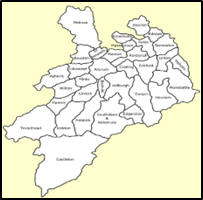
When Sir Archibald Douglas succeeded to the
barony of Cavers in 1382, the entire estate comprised an area of almost
10,000 acres, stretching from the lower River Rule to the southernmost
reaches of Teviotdale. Its parish contained, in its northern division,
the village of Denholm, 5 miles NE of Hawick, and, in its southern
division, Shankend station, 7 miles SSE of Hawick. Very irregular in
shape, being cut in two by Kirkton parish except for a narrow connecting
link to the E, it is bounded NW by Wilton and Minto, E by Bedrule and
Hobkirk, S by Castleton, and W by Teviothead, Kirkton, and Hawick.
Archibald was clearly of a charitable
disposition, as shortly after inheriting the estate he sold the lower
portion to Thomas Cranstoun for the princely sum of one silver penny per
annum. That area, which included Denholm and Spittal, was significant to
the Black Douglases, as it included a hospital of their patronage for
the diseased and the poor. Sir Archibald was responsible for the
construction of Cavers Tower on the site of the original castle,
believed to have been built in 1200.
Some turbulent years lay ahead, and in
particular during the 16th century. After the
Battle of Flodden in 1513 when 200
men from Cavers, Hawick and surrounding villages lost their lives, a
skirmish took place the following year at
Hornshole, about 2 miles from
Hawick. The Flodden loss was still a raw wound for Scots, and
particularly in Hawick where almost all of the town’s adult male
population had been wiped out in that battle. Now, a year later, English
raiding parties under the overall command of Lord Thomas Dacre, were
periodically raiding the Scottish Borders and one group under the flag
of the Bishop of Hexham who were returning home had camped overnight at
Hornshole. Word of their presence had quickly spread, and callant youths
from Hawick and its surrounding areas assembled before riding off into
the night armed with whatever weapons they could find, to bravely
confront their nemesis. They soundly chastised the raiders, capturing
the bishop’s pennon in the process, before returning home victorious.
Although this by no means made up for Flodden, it was nonetheless an
important morale-boosting victory for the youths, achieving a limited
form of revenge on behalf of their late fathers, brothers, grandfathers
and uncles.
 |
|
The Return from Hornshole
1514
|
Hornshole was within the Cavers Estate, and in
1919 Captain Edward Palmer Douglas readily granted permission for a
Memorial Cross to be erected there, just one of several local landmarks
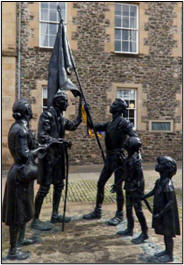
commemorating the event. Perhaps most striking is the “The Return from
Hornshole 1514” collection of bronze figures in Hawick’s High Street
which was commissioned by the Hawick Common-Riding Committee and
comprises a young lad holding the flag and being welcomed back to the
town by an elderly couple and a young boy and girl, whom we are left to
speculate might be the surviving members of his immediate family. The
event is still commemorated to this day during the annual Common Riding
celebrations, when a replica of this flag is symbolically carried by a
young unmarried male (the Cornet).
Probably in part due to the embarrassment that
Hornshole caused Lord Dacre, Cavers was regularly singled out for attack
by English expeditionary forces as part of regular assaults on the
Scottish Borders, as follows:
• 1524 – Dacre laid waste the entire
Borders region, in his words “not leaving a habitable place”
• 1535 –
Dacre returned accompanied by his brother Christopher and Walter Scott
of Branxholme, this time burning and pillaging the Hawick area including
the burning of Cavers and Denholm
• 1542 - Jak of Musgay and Little
John Heron burnt Cavers as part of a raid which extended to the Caill
Water and in Teviotdale
• 1545 – the Earl of Hertford invaded the
Borders with nigh on 4,000 men and systematically “brent, raced, and
cast doune" Cavers, Denholm, Hassendean and Bonjedward as well as eleven
other settlements
• 1570 – the Earl of Surrey plundered the entire
area with Hawick, Cavers, Denholm and Jedburgh being laid waste and
burned.
• 1596 – Townhead of Cavers was raided and completely
destroyed by Sir Henry Widdrington, never to be rebuilt with most of its
inhabitants re-settling in Denholm village.
Nine generations after Sir Archibald Douglas
had sold the Denholm and Spittal farms, in 1658 his namesake (10th)
bought them back in 1658, re-incorporating them into the Cavers Estate.
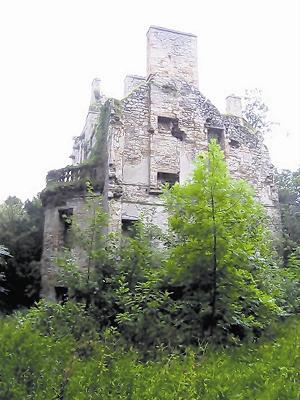
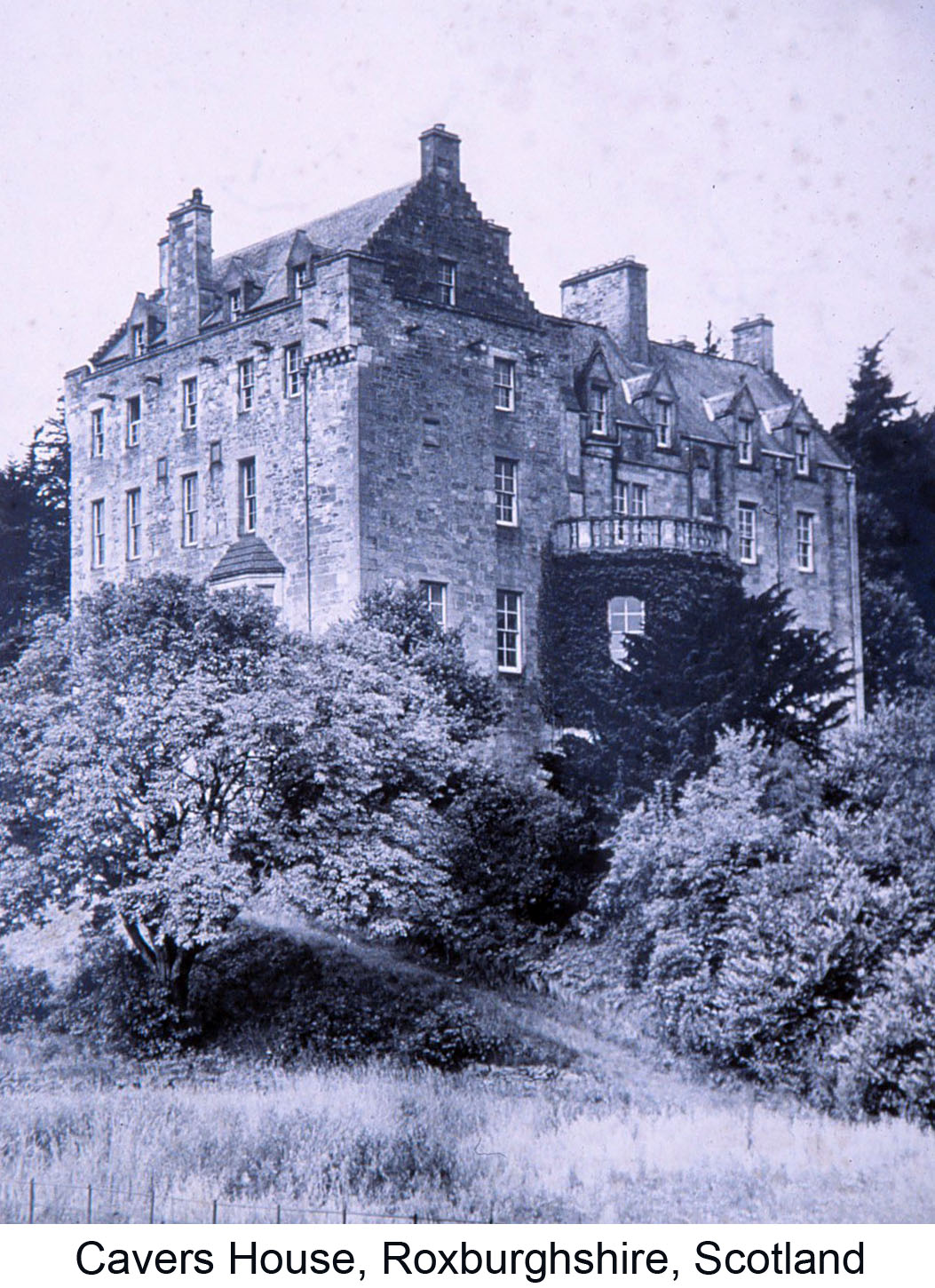
Built mainly between 1750 and 1884, the large
mansion known as Cavers House grew around a lofty tower which formed its
SE. side; but this tower, which was known locally as the "Warden's
Tower", may itself have been a secondary construction imposed upon the
remains of an earlier part of the building, although that of course
depends on how much remained after its earlier frequent ravaging.
Unfortunately, there are no details to tell that tale, and in subsequent
years the tower underwent such extensive alteration that little if
anything remained by which it could be dated. Its 35’ x 17’ interior,
however, suggested it was construction in the later 15th or early 16th
century.
|
|
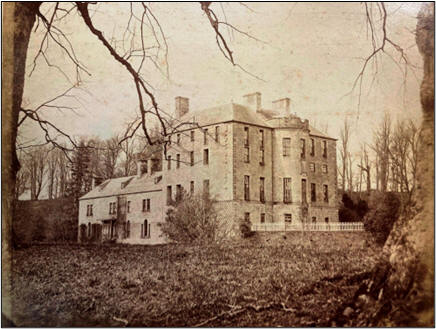
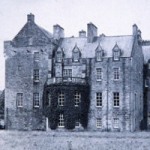
South East aspect clearly showing
the three-storey bowed section (1860) |
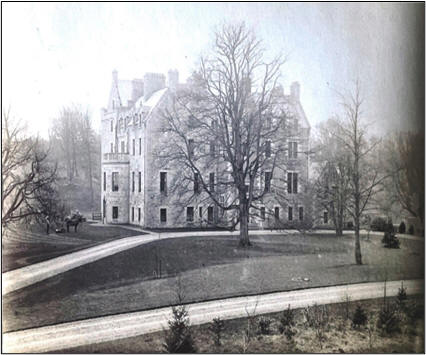
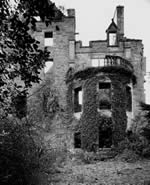
Post-alteration view from North East
aspect, clearly showing the smaller
two-storey bowed
section |
The first extension of the tower was in 1750
when a classical Italian-styled “Sheriff’s Mansion” wing was constructed
in whinstone. The relative peace between England and Scotland by that
time meant that the keep’s former role to defend was no longer
paramount, so the extension included a new 7-bay façade thrown out to
the N in alignment with the E gable, as well as a three-storey bowed
addition and further extensions to the W with Venetian windows.
According to an article in “ck Archaeological Society Transactions”
this transformed the house into “a handsome four storey house with a
classical face, its entrance in the centre and the chief rooms above it
bow-fronted up to roof level”. It also contained “The Blue Room” which
held an extensive library, to which the locally renowned Scottish
dologist John Caspar Leyden of Denholm was permitted free access for
much of 1794 to aid him in his study of Eastern languages. This was
obviously a time of prosperity on the estate as there were nineteen
servants as well as cooks, chambermaids, kitchen maids, housekeepers,
footmen and gardeners all in gainful employment at that time.
There was little by way of alteration to the
house during the next 180 years. When Mary Douglas Malcolm Douglas
inherited the estate in 1878, for Lands Valuation (Scotland) Act 1854
taxation purposes it was calculated to be 9,840 acres with an annual
rental valued of £7,937 which included a notional rental value for
owner-occupied and unlet properties. Mary had grand plans for the
modernisation of Cavers House itself, with a period of extensive works
commencing in 1880 over a seven-year period.
The transformation was according to fashionable
Victorian tastes with a new red sandstone (using materials from nearby
Denholm Hill Quarry) entrance wing to the North and further extensions
to the North-West including a service range on the lower floor which
contained a Boiler room, all sorts of Work rooms and the Butler’s
Pantry, with an adjacent garage and laundry. The old tower house which
formed the SE corner was given gabled attics, its windows were altered,
an oriel window was added, and the bowed section was reduced to two
storeys where the new dining room was located. The library was situated
on the 1st floor above the entrance, with the main bedroom (converted
from the old “Blue Room”) above it, whilst the living room (“The Green
Room”) benefitted from a built-out bay window with further bedrooms
above. Other chambers included a drawing room and a divinity room,
presumably for moments of quiet religious contemplation.
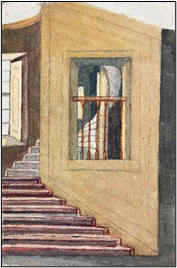
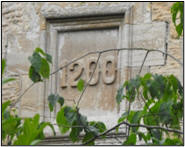
A date stone reading 1200 was fixed to the E
wall, referencing the oldest parts of the tower. Much of the antiquity
was destroyed during this period of activity (during which two children
were born); especially the near unique double spiral stairway. The
design was known as "Stairs of Reconciliation" because the two
intertwined spiral staircases allowed for independent ascent and descent
while also providing moments where the paths converge. Due to the
significant costs involved, their actual incorporation was very rare,
and they were considered masterpieces of the time. Unfortunately, walls
can’t talk, so this particular one was probably incorporated into Cavers
in the late 16th century, whilst earlier versions still exist at Château
de Chambord, Centre-Val de Loire in France and also at Graz Castle in
Austria. An irony here is that had the staircase been retained, the
building would undoubtedly have become listed and would still be in
existence today.
After an all too brief hiatus, work in 1890 to
remove a long-arched internal vault above the first floor (which ran the
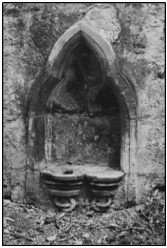
entire length of the E wall) disclosed the presence of a fine
13th-century piscina-niche near the east end of the S wall. It had a
foiled head, and when first uncovered was enclosed by a plain circular
moulding which an ignorant mason removed to make the feature flush with
the wall. The niche-opening measured 2’ 3” in height, 1’ 4” in width and
7” deep, while the sill, shaped on the dexter side as a piscina and on
the sinister side as a credence, projected out by a further 3” being set
out on two moulded brackets formed like capitals of the period, the
lowest member of each being cone-shaped with a floriated end and
finishing downwards in a thumb-knot.
The house, itself a little SE of the parish
church, was now a large 64 room rectangular pile, baronial in aspect,
with an 8’ 6” thick S wall, whilst the E & W were an even more
impressive 14’.On plans of the time, it was shown to consist of an
oblong block measuring about 50 ft. along the S wall by 29 ft. over the
E gable. The W gable, however, showed a re-entrant angle at its S end
measuring 8 ft. 6 in. from N to S by 3 ft. 6 in. from E to W. It was
five storeys n height plus an attic. Both the attic and battlements were
wholly modern while the two floors beneath were rebuilt in the 17th
century, with the three lower floors probably dating from about 1500.
The masonry utilised rubble for the most part, but in the lowest part of
the S wall there is a considerable amount of ashlar in large blocks.
None of the windows were earlier than the 17th century, with the
majority being quite modern.
In April 1913, then owner Mary Douglas Malcolm
Palmer Douglas sold Spital Tower Farm and its surrounding woodland to
Thomas Greenshields Leadbetter, and other disposals during her Lairdship
halved the size of the estate to 5,000 acres (450 of which were
woodland) by the time of her passing in 1949. Unfortunately, this
coincided with a period of decline in the Estate’s fortunes, which had
suffered financially during World War II when forests across the country
were felled as timber was crucial for various wartime needs, including
construction, mining, and fuel. However, to make things worse, Mary was
the first Laird of Cavers to die since the introduction of estate duty
incorporated within the Finance Act 1894, which was a tax on the value
of a deceased person's estate and replaced several other death duties,
and sought create a more unified and comprehensive system for taxing
estates upon death. Although Mary’s son Archibald had preceded her two
years earlier, because theirs was a joint Lairdship it was only now that
duties had become due, and her grandson James was now faced with a bill
for £17,000. Put into perspective, that amount would have a purchasing
power of £1.3M in today’s money, which was simply unaffordable due to
the prevailing circumstances at that time.
To provide some perspective, although the
estate was now less than half the size that it was at its peak, it still
contained the lands of Abercorn Estates, Annfield, Ashybank, Birkinknowe
Farmlands, Castle Park, Cauldmill Cottage and Fields, Cavers Gardens,
Cavers Knowes, Cavers Mains, Deanbrae (incl. Toll House & Laundry), Deer
Park, Denholm Hall Farm, Denholm land at Westgate Hall, Denholm Old
School and School House, East Cote, East Middle, East Midgard, Effledge,
Grass Parks, Haughhead land and Sandpit, Kinninghall, Kirkton [Atholl
Cottage - the old Parochial School building, Gamekeeper's Cottage and
Field], Kirkton Farm incl. Kirkton Manse/Church of Scotland General
Trustees, Kirkton Nethertofts, Langrig, Mansefield, Nursery Park,
Sawmill & Park, Trowknowes East, Trowburn Holding, Trowknowes West,
Westcote, West Middles, & Whitriggs,
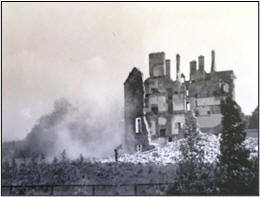
Attempts to sell the house between 1950 and
1953 were unsuccessful, primarily due to high Property Tax rates, so
James was forced into the drastic action of demolishing the property to
avoid that particular tax. To achieve this outcome, he persuaded the
army to use it as target practice in an explosives exercise. During the
weeks leading up to the bombardment, James explained, “I tried to sell
it – at any price. I advertised it up and down the country, I approached
the county council and the government. I asked my M.P., I offered it to
the National Trust. I suggested it might be an hotel, a holiday home, a
school, a hospital, a place for old folk, and I would have let it go for
£4,000. They all said that whatever happened it mustn’t be demolished,
but nobody would take it. So now it goes for whatever its insides will
fetch as scrap, and I’ll be left with a ruin.”
|
|
|
|
Smouldering
remains of
the North aspect (1953)
|
|
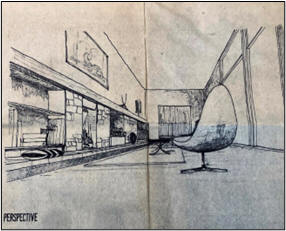
An architect’'s drawing of
a potential living room
in a rebuilt Cavers House
(19th September 1968)
|
However, the death duty bill was still payable,
so everything of worth was sold, not just artwork and antiques but
doors, windows, flooring, bathroom fittings and central heating pipes
too. Even the subsequent rubble had a value and was recycled for other
post-war rebuilding. The Old Wardens Tower had the final say though, as
whilst the army’s explosives brought down the Victorian extensions, it
remains standing to this day as a solemn reminder of the occasion.
The estate remained intact though, but not for
much longer. During the next twenty years other parts of it were sold,
culminating in the disposal of the final 910 acres in 1975. However, the
land upon which the ruins of the house stood remained in James’
ownership, indicating how much that still meant to him. In 2024, to the
surprise of his surviving children, architectural drawings from 1968
were discovered in Hawick Museum’s archives which reveal that James was
looking into the possibility of demolishing the remaining structure and
building a house there. Two different sets from 25th July and 19th
September had been prepared by Edinburgh architects, but for whatever
reason they never came to fruition.
In 1980 James finally sold the ruins and the
land upon which they stand to the late Bill Campbell, thereby
effectively ending the Lairdship. Still on the estate at that time were
two very old horse-chestnut trees, believed to have been planted early
in the 17th century. However, the one that was rooted in the moat near
the entrance to the house was in a dangerous condition with its three
massive trunks being supported by heavy iron chains. Originally the
chains had been wrapped around the tree in an effort to prevent any of
the limbs from falling, but by the early 1990's they had become one with
the tree. Fearing for the welfare of his grandchildren who regularly
played in it, Mr. Campbell decided on safety grounds that it needed to
come down.
It
|
|
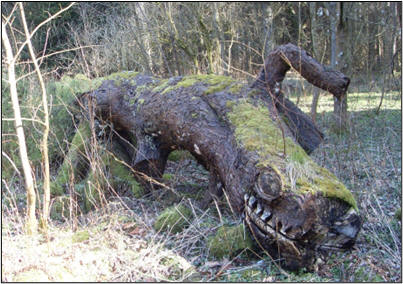
The famous
Cavers
‘crocodile’
|
had been known as “The Douglas Tree” due to
a curse that had been placed upon it; the story being that a witch and
her daughters sought shelter one night in the Cavers Tower but were
discovered by Douglases who turned them out. Upon leaving the witch
uttered a curse on the tree that every time a branch would touch the
ground a Douglas would die. Thus, the heavy iron chains were said to be
protection from the curse. The tree was felled in early October 1995,
and to keep his grandchildren amused Bill Campbell had painted a
'crocodile' on the end of one of its three main trunks. A few days later
former Prime Minister Sir Alec Douglas-Home died. Sir Alex was the last
of the Douglases to grow up in the historic Douglas Castle in Lanark
before its mining-related subsidence required it to be demolished in
1938, so that was quite the coincidence……or not.
The other tree sadly met its end soon after the loss of its
partner when it succumbed to the gale-force winds that originated on the
other side of the Atlantic as Hurricane Opal, and which had swept in
from the Irish Sea eventually reaching SE Scotland on Wednesday 25th
October 1995. Both trees have long since been removed from the estate,
so there’s not even a stump to mark their former presence.
The Douglas connection to Cavers isn’t quite
finished yet though. When James had sold the remaining parcels of
woodland and farmland in 1975, he specifically excluded the small burial
plot to the rear of the Auld Kirk (where he was laid to rest in 2013),
and when he made the final ruins sale in 1980 he stipulated a “Right of
Way” to it for members of the family in perpetuity. It’s only an acre in
size, but although something of a technicality, the Douglases of Cavers
still own land on the estate and thanks to that foresight they will
continue to do so for generations to come.
With thanks to Helen Lorenz Palmer Douglas and
James Ninian Douglas for their help in updating this page in September
2025.
For further reading on the Douglas of Cavers family,
go here>>>
Contributions
Do you have an ancestor whose
story should be told here? Can you add to this article? Please let us have the details.
|
|




.jpg)