This page is a stub.
You can help improve it.
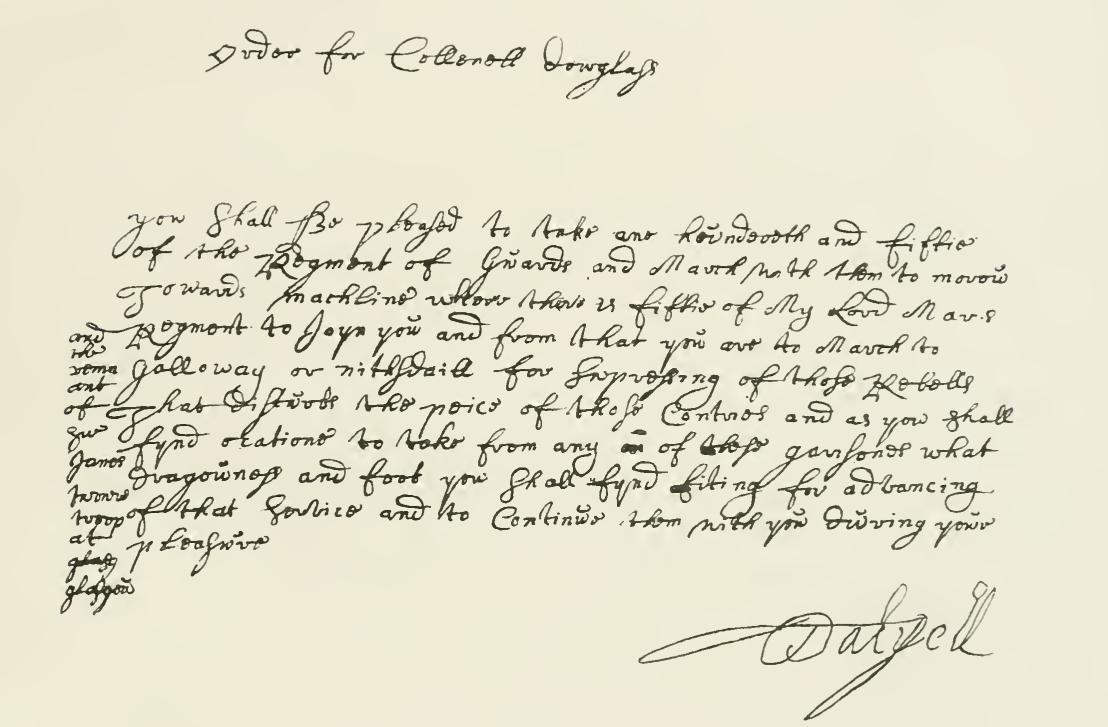
Marching Orders, signed by General Dalyell of Binns, instructed Colonel Douglas to take one hundred and fifty men from the Regiment of Guards and march the next day toward Mauchline, where fifty soldiers from Lord Mar’s regiment were to join him. From there, he was to proceed “to Galloway or Nithsdale for suppressing those rebels that disturb the peace of those countries; and as you shall find occasion, to take from any of these garrisons such dragoons and foot soldiers as you deem fitting for the advancement of that service, and to retain them with you at your discretion.”
Added in the left-hand margin is the note: “And the remnant of Sir James Turner’s troop at Glasgow.” The order is undated and unsigned save for the name “Dalyell.”
James Douglas, brother of the first Duke of Queensberry, was appointed “Colonel to the Regiment of the King’s Foot Guards” in July 1684. By March 1685, he had been dispatched to quell the Covenanters in the western shires—although the ministers of Galloway claimed that “Claverhouse’s name was more formidable there.”
According to Kirkton, “Sir James Turner and Sir William Bannatyne had, by their cruelties, driven the poor people of Galloway into despair; but,” he adds, “they were saints compared to Tam Dalyell and his soldiers.”
In Captain Creichton’s oft-quoted description of Dalyell’s unusual appearance, it is stated that “he never wore boots.” However, John Howie, in his account of Captain Paton, describes a pistol ball “hopping down upon Dalziell’s boots,” and both the boots and his sword are reportedly still preserved at Lingo House.
If the story of the white flag, recorded by Dr. Simpson, can be credited, Dalyell—despite his harshness and cruelty—honourably kept a promise made to a Covenanter who had spared his life. Moreover, as later accounts would show, he possessed enough humanity to feel sorrow for an old comrade in danger, though now fighting for the other side.
He died in August 1685.
For more on 'The Covenanting Times', see the articles in the directory
below
|
Contributions
Do you have an ancestor whose
story should be told here? Please let us have the details.
Source
Sources for this article include:
Scottish National memorials; edited by James Paton; 1890