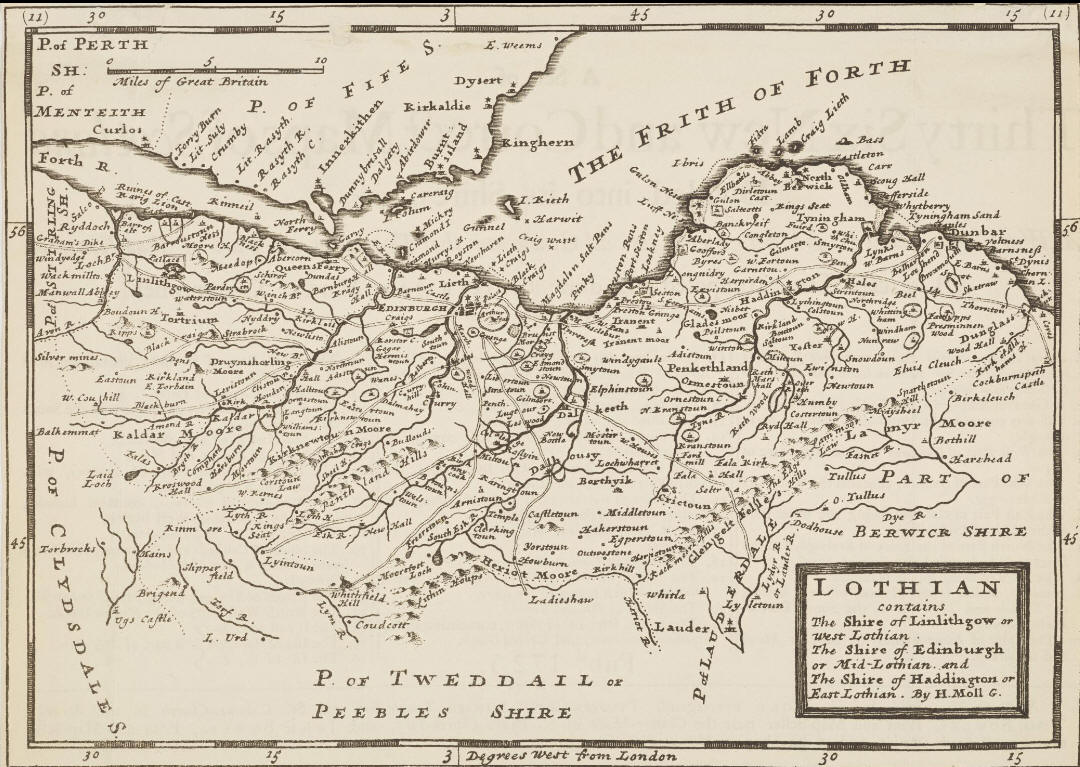
The Integration of the Lothians into Scotland and the Douglas
Family Influence
The Lothians, a region comprising
present-day East Lothian, Midlothian, and West Lothian, have a storied
history that culminated in their incorporation into the Kingdom of
Scotland. This process involved a series of strategic alliances,
battles, and evolving political dynamics, further influenced by the
powerful Douglas family.
Initially, the Lothians were part of the
Anglo-Saxon kingdom of Bernicia, which merged with the kingdom of Deira
to form Northumbria in the 7th century. Northumbria's dominance extended
over much of what is now southern Scotland, including the Lothians. This
era saw significant cultural and religious influence from the
Anglo-Saxon world, with Christianization efforts spreading throughout
the region.
By the late 9th century, the power of Northumbria
began to wane. Viking invasions and internal strife weakened
Northumbrian control, providing an opportunity for neighboring kingdoms
to assert their influence over the Lothians.
A critical moment in
the Lothians' integration into Scotland occurred in the 10th century.
Scottish king Constantine II formed key alliances with the Strathclyde
Britons and the Norse-Gael rulers of Dublin. In 937, the Battle of
Brunanburh decisively ended Northumbrian attempts to regain control over
their former territories. King Indulf (954–962) later capitalized on
Northumbria's further decline and secured control over the Lothians,
marking a significant step in their incorporation into Scotland.
The Role of the Douglas Family
The Douglas family played a
pivotal role in the region's history. In 1315,
James Douglas of Lothian,
father of William Douglas, Lord of Liddesdale, received lands in Lothian
from King Robert I. This acquisition solidified the Douglas family's
presence and influence in the area. William Douglas, Lord of Liddesdale,
furthered this legacy by seizing control of Liddesdale from the English
around 1337 and capturing Hermitage Castle the following year. His
strategic maneuvers and military prowess earned him the title of "the
Flower of Chivalry." His efforts significantly bolstered Scottish
authority in the region, ensuring that the Lothians remained firmly
under Scottish governance.
King Edgar of Scotland (1097–1107)
formalized the region's integration by distributing lands and
establishing Scottish law. This move not only secured loyalty from the
local populace but also ensured that the Lothians were firmly under
Scottish governance. The Douglas family's continued presence and
influence in the area reinforced this control, as they became key
figures in the local power dynamics.
The incorporation of the
Lothians into Scotland had a profound impact on the cultural and
economic landscape. The region became a hub of agricultural productivity
and trade, contributing to Scotland's overall prosperity. The melding of
Anglo-Saxon and Gaelic cultures enriched the societal fabric of medieval
Scotland, laying the groundwork for a united kingdom.
Contributions
Do you have an ancestor whose
story should be told here? Please let us have the details.
|