The Douglas Clan and the Darien Scheme: A Legacy of Ambition and Sacrifice
The Darien Scheme remains one of the most pivotal "what-if" moments in Scottish history—a bold attempt in the late 1690s to establish a world-class trading colony on the Isthmus of Panama. Central to this ambitious venture was the House of Douglas. Based on the subscription rolls of the *Company of Scotland* and historical manifests, the sheer volume of "Douglases" involved highlights how deeply this historic clan committed its wealth, blood, and political reputation to the venture.
High-Ranking Investors: The Power Behind the Purse
The Douglas nobility and gentry were key financial backers, viewing the expedition as both a patriotic duty and a strategic investment. For many, these subscriptions were a mix of personal wealth and "political signaling" to show support for Scottish independence.
| Name |
Title / Significance |
Investment |
| James Douglas |
2nd Marquess of Douglas (Head of the House) |
£1,000 |
| James Douglas |
2nd Duke of Queensberry (Lord High Commissioner) |
£3,000 |
| Lord William Douglas |
Earl of March (Son of the 1st Duke of Queensberry) |
£1,000 |
| Archibald Douglas |
Brother to Sir William Douglas of Cavers |
£500 |
| Sir William Douglas |
Of Cavers |
£500 |
| Henry Douglas |
Keeper of the Signet |
£300 |
| Alexander Douglas |
Major to His Majesty’s Troop of Guards |
£200 |
The Settlers and Voyagers: Life on the Front Lines
While the nobility provided the capital, other members of the clan risked—and often lost—their lives. These men sailed toward "Caledonia" facing tropical disease, Spanish hostility, and eventual starvation.
• George Douglas: A soldier of the first expedition. He is remembered by historians for three poignant letters sent to his family in Fife in 1699, detailing the brutal hardships of the jungle. Records suggest he did not survive the venture.
• James Douglas: A carpenter from Edinburgh who sailed on the *St. Andrew* in July 1698. He left behind a wife, Katherine Waterstone, and two children, James and Christian.
• John Douglas: Grandson of George Douglas of Waterside; records from the *Douglas Archives* confirm his death at Darien.
• Captain Douglas: The son of Colonel Sir William Douglas, he served as a military officer tasked with defending the fragile colony against Spanish incursions.
The "Middling Sort": Merchant and Local Support
The involvement of the Douglas clan extended far beyond the high aristocracy. Local merchants and family branches often pooled their resources to support the national cause:
• Robert Douglas (Senior & Junior): Known as "soap-boylers" from Leith, these entrepreneurs were notable rivals in the soap trade and invested £100.
• Robert & William Douglas: Respective merchants in Edinburgh and Dalkeith who saw the trade potential of the Panama route.
• The Women of Douglas: Significant female investors included Mary Douglas (Lady Hilton) and Susanna Douglas, the widow of Glasgow merchant Ninian Anderson, both of whom appeared as independent subscribers.
Why the Douglas Involvement Matters
Historically, the Douglases were the "Wardens of the Marches," the legendary defenders of the Scottish border. By the 1690s, their power was transitioning from the sword to the checkbook. This shift reached a controversial climax when the scheme collapsed, leaving Scotland bankrupt.
Because James Douglas, 2nd Duke of Queensberry, was the man who ultimately presented the Treaty of Union to Queen Anne in 1707, many Scots at the time viewed the Douglas role with suspicion. Some saw the failure of Darien—a venture the family helped fund—as the perfect excuse for the Duke to merge Scotland with England in exchange for financial compensation.
Notes:
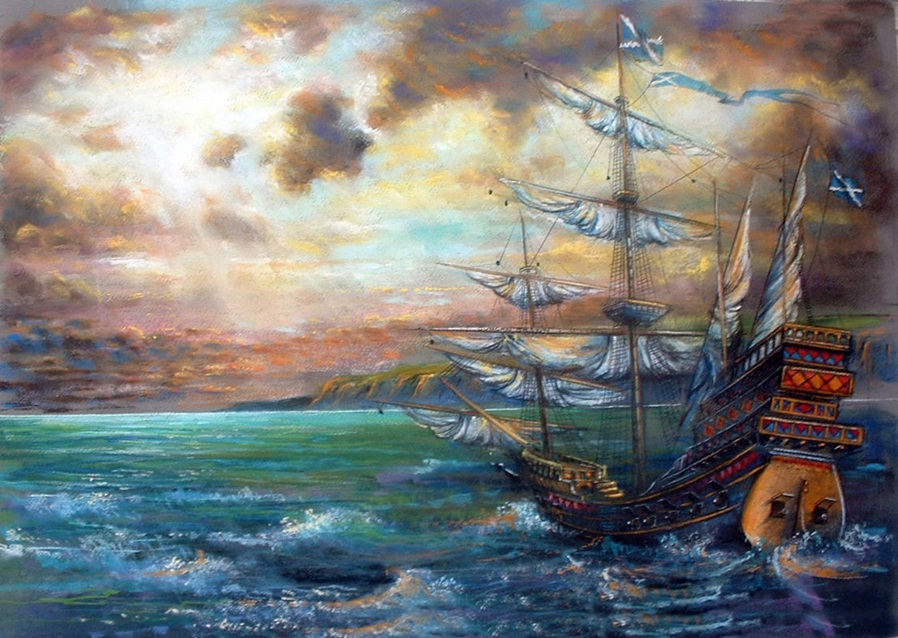
1. The illustration is by
Duncan Brown, who writes: Half of the coinage of Scotland was raised for an
expedition to an area of the world between north and south America, where the idea was to cut a short channel in that area, so that all the shipping of the world could use that shortcut, rather than have to travel all the way to the bottom of Sourh America and back up again. A tremendous saving of time and energy. The Scots who worked that out knew that we could possibly become one of the richest nations in the world by controlling and collecting the monies to allow this shortcut. King Billy in England was made aware of this, and the possibility of Scotland becoming so rich and powerful. It was said that whoever controlled that small stretch of land would become the richest nation on earth. So, our ' friends' from south of the border PAID everybody and anybody there to harass, starve, and chase the Scots from that area . The Spanish, the local Indians and their own English fleet would ensure that it would be impossible to continue with the expedition. Thousands died in two attempts at the quest, and Scotland was all but turned in to what looked like a third world country .That was the point when Scotland was forced to sign the document that joined us to England in 1707.
Contributions
Do you have an ancestor whose
story should be told here? Can you add to this article? Please let us have the details.
See also:
•
List of Douglases
investors
|