The Douglass Dynasty: From Yorkshire Lore to Geelong’s Gilded Age
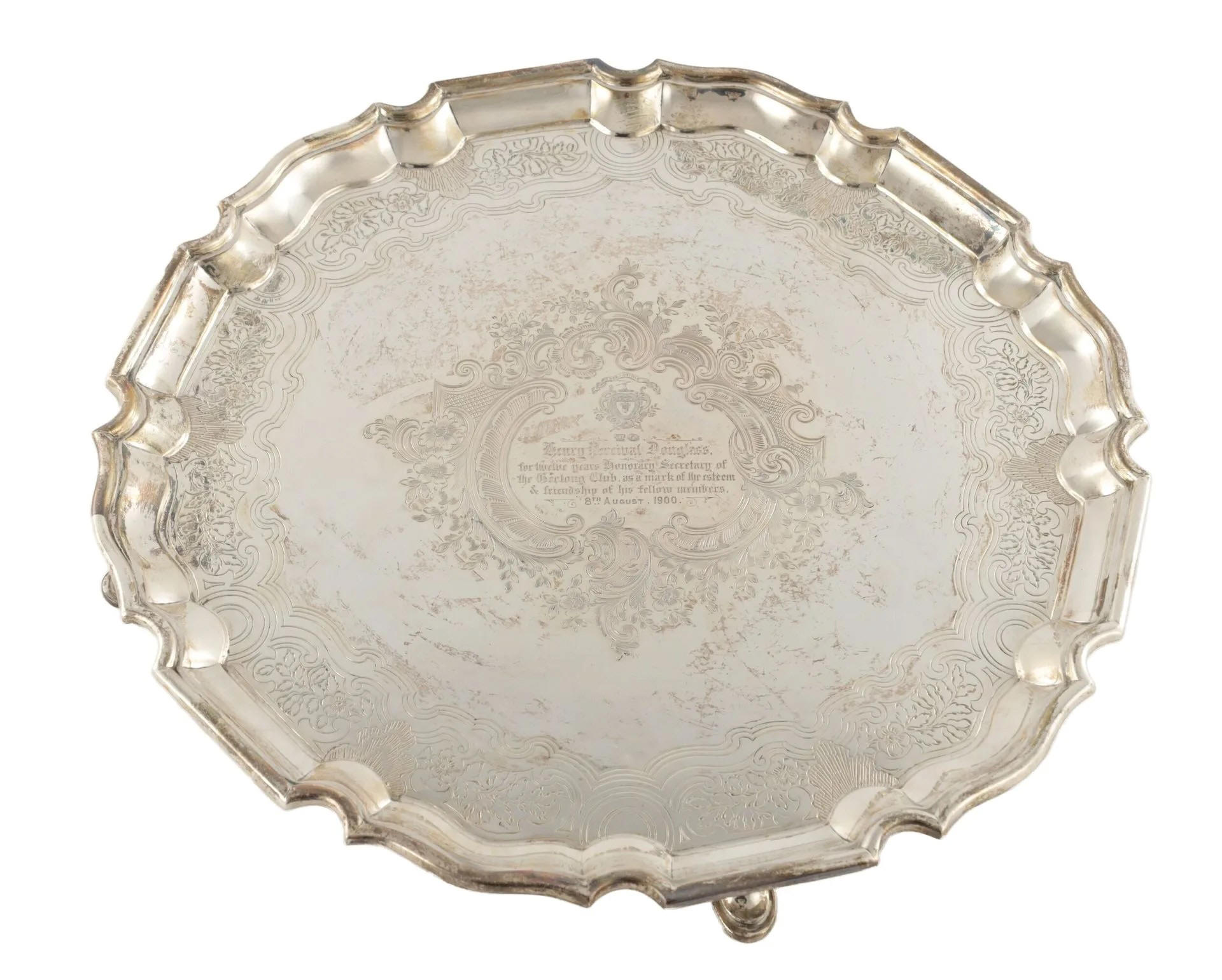
The silver salver presented on August 8, 1900, serves as a gleaming window into the "Golden Age" of Victoria’s colonial society. Its central inscription tells a story of deep civic gratitude:
"Henry Percival Douglass. for twelve years Honorary Secretary of the Geelong Club, as a mark of the esteem & friendship of his fellow members. 8ᵀH AUGUST, 1900."
While the gift commemorates his tenure at the Geelong Club - the city’s premier private social institution for the pastoral and merchant elite
- it represents a tangible link to a family whose influence defined the region’s legal, sporting, and industrial history for over a century.
From Yorkshire Roots to the English Midlands
The origins of the Douglass lineage are steeped in an evocative oral tradition that traces back to John Douglass of Yarm, Yorkshire. Though the family later became established in the English Midlands, they carried with them the lore of the English Catholic revival and a storied connection to the Jacobite cause. Family legend even whispers of an ancestor who met Bonnie Prince Charlie during the 1745 uprising, receiving a miniature portrait as a royal token.
By the early 19th century, the family had settled in Loughborough, Leicestershire, where the patriarch of the Australian branch, Alfred Douglass (1820–1883), was born to James and Clarissa Douglass. Though the family name is famously Scottish (Clan Douglas), this immediate branch was a fixture of the English Midlands before seeking a new life in the colonies.
The Move to Australia: A Two-Stage Journey
The family’s move to the Southern Hemisphere predates the founding of the colony of Victoria. It occurred in two distinct stages:
* Tasmania (1835): Alfred left England as a teenager, arriving in Hobart aboard the *Wave*. He joined his half-brother, Charles Thomas Douglass Smith, a founder of Webster Limited—one of Australia's oldest continuously operating companies. It was here that Alfred mastered the wool trade that would eventually make his fortune.
* Geelong (1850): Alfred moved to Geelong just as the Victoria colony was separating from New South Wales. He quickly established himself as a titan of industry, famously conducting the first wool sales in Victoria’s history and acquiring the *Geelong Advertiser*, the colony’s oldest morning newspaper.
The "Cast Iron" Legacy and London Ties
The family's most enduring physical link to the United Kingdom is Corio Villa. When Alfred purchased land on Eastern Beach in 1856, he acquired a prefabricated cast-iron house manufactured in Edinburgh, Scotland, by Charles D. Young & Co. Originally ordered by a commissioner who died before its arrival, Alfred bought the "kit" at the wharf and assembled it; it remains one of the most significant examples of Scottish iron-work in the world today.
While the family was firmly Australian by the time Alfred’s sons reached adulthood, a brief return to London in 1859 meant that the salver’s recipient, Henry Percival "Percy" Douglass, was born in the heart of the Empire. This "London-born" status, alongside his mother Elizabeth's Dublin roots, added a layer of prestige to Percy’s profile within the colonial social circles of the Geelong Club.
The Brothers: Muscular Christianity and Civic Leadership
Percy and his brother, Frederick Montague "Monty" Douglass, became icons of the Victorian era, embodying the "muscular Christianity" of the time. Both brothers were star athletes for the Geelong Football Club (the Cats), with Percy playing in four premiership-winning teams between 1878 and 1883.
Beyond the football oval, Percy was a versatile leader:
* The Professional: A respected solicitor and the managing director of the *Advertiser*.
* The Socialite: His twelve-year leadership as Honorary Secretary of the Geelong Club is immortalized by the 1900 silver salver.
* The Sailor: A legendary competitive sailor and Life Member of the Royal Geelong Yacht Club, where the H.P. Douglass Memorial Shield is still contested today.
This salver stands as a tangible link to a man who navigated the highest echelons of society with the same skill he used to captain a yacht or lead a courtroom, marking the peak of a family legacy that stretched from the moors of Yorkshire to the shores of Corio Bay.
See also:
• The
Douglas family in Yorkshire
•
Corio Villa
•
Alfred Douglass
•
Henry Percival Douglass
Contributions
Do you have an ancestor whose
story should be told here? Can you add to this article? Please let us have the details.
|