|
| |
The Douglas's vs. the Crown
|
|
|
Power, Patronage, and English Gold
For more than two centuries, the
name Douglas carried both glory and danger in Scotland. It conjured up
knights on the battlefield, castle intrigues, and the constant friction
between noble ambition and royal authority. But in the early 1500s—when
Scotland wavered between independence and English influence—the Douglas
clan rose to its greatest power and sank into its deepest moral
compromise. Their story in this period isn’t just about a family; it’s
about how patronage, politics, and money from a foreign king nearly
rewrote Scotland’s destiny.
The rise of the “Black Douglases”
The
Douglases had long been power brokers in Scotland. Their bloodline
traced back to the Wars of Independence, their ancestors having fought
beside Robert the Bruce. By the sixteenth century, their wealth, land,
and intermarriages had made them nearly untouchable.
Sir George
Douglas, brother of Archibald Douglas—the sixth Earl of Angus—was
typical of their breed: shrewd, opportunistic, and endlessly adaptable.
His son James (the future Regent Morton) inherited not just estates, but
a political inheritance steeped in both daring and duplicity.
When
James IV fell at Flodden in 1513, Scotland entered a long crisis of
regencies and minority kings. The Douglases saw opportunity. With the
young James V on the throne, and Queen Margaret Tudor (the King’s
English mother) newly widowed, Archibald Douglas made a bold move: he
married the Queen Dowager. Through that marriage, the Douglases gained
not just royal proximity but unprecedented leverage in Scottish
politics.
By 1525, Angus effectively ruled the kingdom in the boy
king’s name. The Douglases filled offices, controlled the treasury, and
wielded royal seals. Scotland had a monarch in name—but a Douglas in
practice.
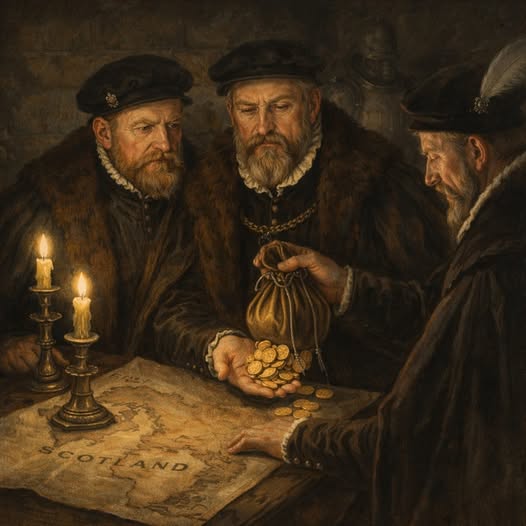
The golden trap: English pensions and political betrayal
Their dominance might have endured, but ambition often comes with a
price tag. Henry VIII, the Queen Dowager’s brother, wanted Scotland
subdued—or, better still, joined to England. He recognized that bribery
was cheaper than invasion. English gold flowed northward to buy
influence, and the Douglases—especially Angus and his brother Sir
George—were ready recipients.
Surviving documents show the Douglases
accepted money directly from Henry, agreeing to recognize him as their
“supreme lord and sovereign.” The transaction wasn’t symbolic; it was
treasonous. In exchange for pensions and promises, they served English
interests from within the Scottish government.
But politics is rarely
static. Young James V soon realized he was a prisoner in his own
kingdom. In a story worthy of legend, he escaped Douglas control in
1528—slipping out of Falkland Palace at dawn, galloping to Stirling with
only his groom for company. By nightfall, he had declared the Douglases
traitors and banished them from the royal court.
The mighty house
that had ruled Scotland for three years was suddenly outlawed. Their
estates were seized; their supporters scattered. The Douglases fled to
England—ironically, the same power they had been secretly serving.
Exile and education in England
For the next fourteen years, Sir
George Douglas and his son James lived in exile, mostly under English
protection. Henry VIII rewarded their betrayal with shelter, but not
freedom. They were political pawns, to be used when Scotland needed
stirring up or divided.
During this exile, young James Douglas
absorbed a kind of dual education—part English diplomacy, part
continental observation. He learned to negotiate, to dissemble, and,
perhaps, to distrust idealism. He also encountered early Protestant
ideas, especially through England’s own religious reforms. These
influences would later shape him into one of Scotland’s most pragmatic
(and least sentimental) reformers.
But when Henry began demanding too
much—claiming overlordship of Scotland outright, and pressing for the
infant Mary’s marriage to his son—Scottish opinion hardened. Even among
exiled nobles, the realization dawned that England’s “protection” meant
absorption.
The Douglases’ usefulness waned, and when James V died in
1542, the political tide turned again. The banished family saw their
chance to return home.
Return, redemption, and lingering suspicion
By 1543, the Douglases were back on Scottish soil. Sir George resumed
his talent for quiet scheming; James Douglas began the cautious climb
that would one day take him to the regency. Yet the family’s reputation
never fully recovered. Their earlier collaboration with Henry VIII had
left a permanent stain.
In the shifting sands of Reformation
Scotland, the Douglases often seemed to move with the strongest
wind—Protestant or Catholic, royalist or rebel, depending on the
advantage. To their admirers, this was political realism. To their
critics, it was moral bankruptcy.
Even the future Regent
Morton—hardworking, austere, and capable—carried that inherited
ambivalence. His later achievements in bringing order to the kingdom
couldn’t erase the memory of the time when his house had “sold Scotland
for gold.”
Power and peril
The Douglas-Crown feud illustrates one
of Scotland’s oldest political patterns: the struggle between strong
nobles and a fragile monarchy. Each time the Douglases rose, the king’s
power shrank; each time a king matured enough to rule, the Douglases
fell.
By the end of the sixteenth century, after Morton’s execution
in 1581, their star had dimmed—but their pattern had not. The recurring
drama of Scottish history—between authority and ambition, nation and
neighbour—played out again and again in their story.
The Douglases
proved that wealth, titles, and even royal marriages could not buy
safety when loyalty itself became negotiable. English gold could
purchase influence, but it could not buy back trust once lost.
The
family’s motto might well have been “Attempto”—“I try.” They tried to
rule, to reform, to survive. And in doing so, they embodied both the
brilliance and the peril of power in a small, turbulent kingdom balanced
between independence and annexation.
Adapted From: Ross, W. (1885).
Aberdour and Inchcolme: Being historical notices of the parish and
monastery, in twelve lectures. Published by D. Douglas.
Originally posted on Facebook
'Clan Douglas Heartland' by Don Justyne, of Pinehurst, North Carolina
Contributions
Do you have an ancestor whose
story should be told here? Can you add to this article? Please let us have the details.
|
Source
Sources for this article include:
Ross, W. (1885). Aberdour and Inchcolme
Any contributions will be
gratefully accepted
|
|