This page is a stub.
You can help improve it.
Alexander Douglas was one of the four
sons of James Douglas of Inchmarlo who obtained a Charter under the
Great Seal of the Lands of Inchmarlo in 1664, and Isabel, daughter of
David Ramsay of Balmain. Alexander was Professor of Hebrew at Edinburgh
University, to which he made several donations and bequests.
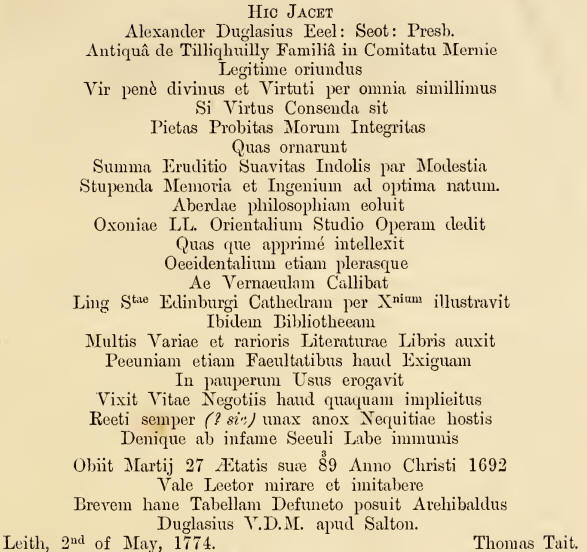
The following inscription from the pen of
Archibald Douglas, minister
of Salton, and transcribed from a copy signed and dated 1773, has not been traced. But it may, perhaps, be reasonably inferred from the fact of a copy having been taken no less than 80 years after the Professor's death, that the inscription had been erected and was then extant.
Click to enlarge |
|
Notes on the Text and Its Language
Orthography and
Scribal Features
The inscription survives in a later copy,
and several spellings reflect either eighteenth-century habits
or the transcriber's ear:
- Eccl: Scot: Presb. — a
standard abbreviation for Ecclesiae Scoticae Presbyterianae.
- Tillyquhilly, a known estate in the parish of Banchory-Ternan,
Kincardineshire.
- Mernie — the Mearns (Kincardineshire).
- Aberdae — Aberdeen.
- LL. Orientalium — Linguarum
Orientalium, the Oriental languages.
- Cathedram per Xninm —
likely per X annos or per X minimum; the copyist’s “Xninm” is
ambiguous.
- Recti semper f? siij unax anox — a corrupt
reading; the sense is clear (“always a follower of what is
right”), but the original wording is uncertain.
These
quirks are typical of eighteenth-century manuscript
transmission, especially when copying older stones or tablets
already weathered by time.
Biographical
Context
Origins in the Mearns
Tillyquhilly appears in
seventeenth-;century records as a small estate associated with
local gentry and clerical families.
Education and
Scholarship
The inscription paints a portrait of a man of
exceptional learning:
- Aberdeen: A centre of
philosophical and theological training.
- Oxford: His study
of Oriental languages suggests engagement with Hebrew, Syriac,
and possibly Arabic — skills prized among Reformed scholars for
biblical exegesis.
- Western languages: The phrase implies
competence in Latin, Greek, and perhaps several European
vernaculars.
The emphasis on memory, modesty, and
sweetness of character reflects the classical virtues expected
of a learned divine.
Edinburgh and the Chair of Divinity
His tenure in the Edinburgh Chair of Divinity (though the exact
years remain unclear) situates him among the intellectual elite
of the Scottish Kirk. His contributions to the University
Library — “many books of various and rare learning” — hint at a
personal collection of considerable breadth.
Charity and
Moral Character
The inscription is unusually explicit about
his generosity to the poor and his moral independence from “the
stain of a corrupt age.” Given the turbulence of
seventeenth-century Scotland — Covenanting struggles, episcopal
restorations, and political upheaval — this may reflect a
reputation for principled steadiness.
The 1774 Tablet by
Archibald Douglas
The memorial was erected not at the
time of Alexander’s death but eighty-two years later, in 1774,
by Archibald Douglas, minister at Salton. This act of
retrospective commemoration suggests:
- a continued
family pride in Alexander’s scholarship;
- a desire to
preserve a fading inscription;
- or perhaps the rediscovery
of a manuscript or stone needing renewal.
The closing
name “Thomas Tait” may indicate the mason or the scribe
responsible for the transcription.
Contributions
Do you have an ancestor whose
story should be told here? Can you add to this article? Please let us have the details.
|