This page is a stub.
You can help improve it.
Morham Castle and the Douglases of the Sixteenth Century
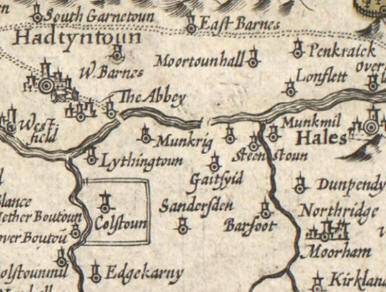
Morham Castle stood in East Lothian, a short distance south‑east of Haddington, on a rise immediately south of Morham Kirk and overlooking the Morham Burn. Nothing survives above ground today, but its position is securely known from historic mapping and recent archaeology.
Morham formed an early point of contact between the Douglases and the old East Lothian families who held the lands long before the rise of the great Border houses. The estate was originally the seat of the Morham or Malherbe family, but by the fourteenth century it lay within the sphere of the Earls of March and the Hepburns of Hailes, both of whom intermarried repeatedly with the Douglases. Through these alliances the Douglases became entangled in the political life of Morham, most notably during the turbulent years of the late sixteenth century when the forfeiture of Francis Stewart, Earl of Bothwell, brought Morham into Crown hands. The Douglases of Whittingehame
- kinsmen of the Morton line - were active in the region and appear frequently in the same records as the Morham lands, while the Earls of Morton themselves held neighbouring estates and exercised jurisdiction across much of East Lothian. Although no Douglas branch is known to have possessed Morham Castle outright, the family’s presence is woven through its history: in marriage alliances with the Hepburns, in the Morton influence over the district, and in the wider political networks that shaped the fate of Bothwell and his forfeited estates. Morham thus stands not as a Douglas stronghold, but as a place where the family’s alliances, rivalries, and regional authority intersected with the shifting power structures of East Lothian.
Origins of the Lands and Early Fortification
The lands of Morham were first granted in the 12th century to Thomas de Morham, previously known as Thomas Malherbe. This early charter suggests that a fortified residence
- whether a timber hall, earthwork, or early stone structure - likely stood on the site from this period. The Morham family retained possession for more than a century, until 1322, when the estate passed to Sir John Gifford of Yester, marking the first of several significant changes in ownership.
Throughout the medieval and early modern periods, Morham changed hands repeatedly, sometimes through inheritance, sometimes through royal grant. Its strategic position in East Lothian ensured that the estate remained of interest to powerful families and to the Crown.
The Castle in the Sixteenth Century
By the late 1500s, Morham was clearly recognised as a fortified site. A royal charter of 1585,
granting the lands of Morham and Hailes to Francis Stewart, Earl of Bothwell, explicitly refers to the “tower” and “fortalice” of Morham. These terms confirm the presence of a defensible stone structure
- almost certainly the later Morham Castle.
Lady Morham lived in the castle until her death in 1572 and in October 1573 a tack of the lands and barony of Morham, together with various other lands in the parish, was made to her daughter Jean Hepburn, Mistress of Caithness. Jean’s third husband was
Archibald Douglas, Parson of Douglas, who was also involved in the murder of Darnley. In 1580 Douglas escaped from the castle at Morham just prior to his intended arrest by Alexander Home of Manderston, having been warned by his kinsman George Douglas of Longniddry.
In 1581 James VI granted numerous possessions including Crichton, Hailes and Morham, with tower and mill, to his cousin, Francis Stewart, 5th Earl of Bothwell. Francis had been born in Morham Castle in 1562 and was the maternal nephew of the 4th Earl. The 5th Earl had married Margaret Douglas, daughter of
David Douglas, 7th Earl of Angus, and widow of Walter Scott, 4th Baron of Buccleuch, in 1577.
The 5th Earl fell out favour with the King in the second half of the 1580s and was accused of treason in 1589. He was found guilty but sentence was deferred however in April 1591 he was arrested for trying to arrange the King’s death through the practice of witchcraft and imprisoned in Edinburgh Castle. On the 22nd of June he escaped from the castle and three days later was proclaimed an outlaw. On the 26th of June Morham was granted to Ludovic Stewart, 2nd Duke of Lennox and the King’s second cousin.
The castle was strengthened again in 1593, during a period of political unrest associated with Bothwell's repeated rebellions against James VI. After this date, references to the castle become sparse, suggesting a gradual decline.
18th century
By the 1790s, the Old Statistical Account recorded that:
“although there is not one stone of the castle left upon another, yet there are many people alive who remember the remains of it, and speak of it as a large extensive structure.”
This testimony indicates that substantial ruins survived into the 18th century, even if nothing visible remains today.
Archibald Douglas of Morham: A Notable Resident
One of the most dramatic episodes associated with Morham Castle concerns
Archibald Douglas, M.A., a younger son of Richard Douglas, himself a son of James, second Earl of Morton. Archibald was parson of Douglas around 1560, and like several clerics of his generation, he moved in both ecclesiastical and political circles.
According to Fasti Ecclesiae Scoticanae, Archibald Douglas was accused on 31 December 1580 of being accessory to the murder of Henry, Lord Darnley.
The charge was to be heard before the King and Council. However,
receiving advance warning while at his residence at Morham Castle, he escaped during the night and fled to England early the next morning.
His flight from Morham links the estate directly to one of the most notorious political intrigues of the reign of Mary, Queen of Scots and the early rule of James VI.
Legacy
Although Morham Castle has vanished from the landscape, its history survives through charters, ecclesiastical records, and the memories preserved in local tradition. The estate’s association with the Morham family, the Giffords of Yester, the Earl of Bothwell, and the Douglases
- particularly Archibald Douglas’s dramatic escape - places it firmly within the turbulent political and religious history of medieval and early modern Scotland.
|