This page is a stub.
You can help improve it.
Douglas Flat was a busy mining camp in the early 1850s, settled by Irish and Welsh immigrants seeking gold.
Gold was first discovered near Coyote Creek in the early 1850s, and Douglas Flat soon developed - named for a Mr. Douglas that camped there. The town soon had a church, flour mill, blacksmith, school, and stores and saloons to serve its miners from several different backgrounds.
By 1857, the Harper and Lone Star Claims had produced $130,000 worth of gold. The Central Hill Channel, an ancient river deposit located beneath the Table Mountains, had yielded large amounts of gold over time.
Mining operations extended beyond the main camp to sites like Coyote Creek, Pennsylvania Gulch, Wild Goose Gulch, and Missouri Gulch. Techniques included dredging, placer mining, shaft mining, and hydraulic mining. In the late nineteenth century, Chinese mining companies worked Coyote Creek, contributing to the region's ongoing gold production.
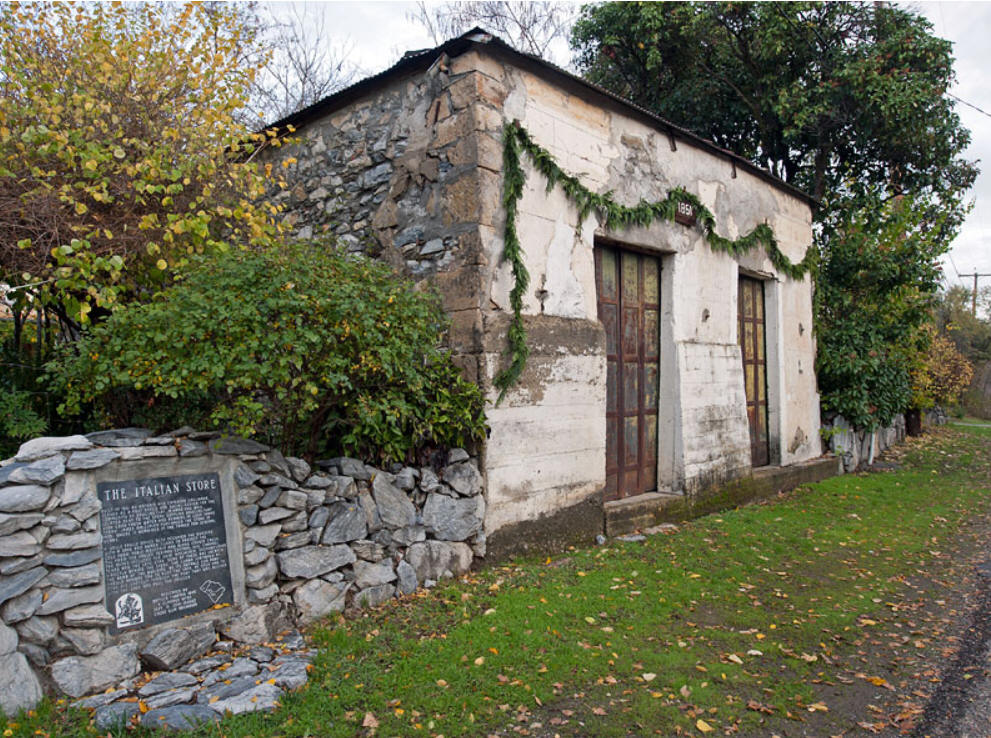
Douglas Flat remained a small town, as it does today. In 1854, miners built a modest structure that served as a church, town hall, and later a school. By the 1860s, three stores had opened, including the Italian Store, a stone building that still stands.
S. A. Perry, one of the original owners of the Murphys Hotel, lived in Douglas Flat and ran a large orchard producing apples, plums, figs, cherries, and apricots. Alongside mining, agriculture and ranching were significant parts of the local economy
Contributions
Do you have an ancestor whose
story should be told here? Please let us have the details.
Source
Sources for this article include:
NoeHill.com |