|
Douglas Connections with Carlisle Castle: A Shared
Borderland History
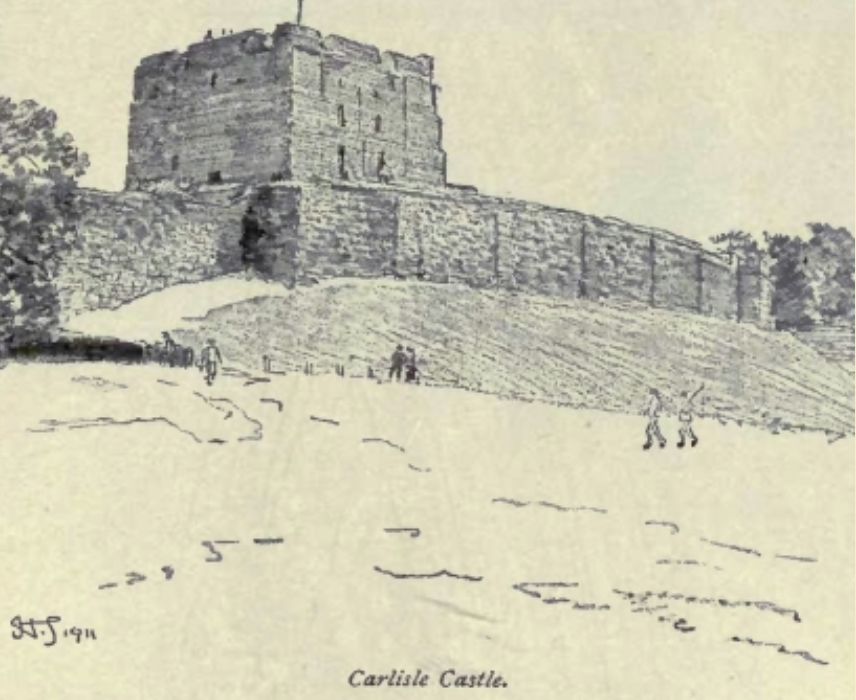
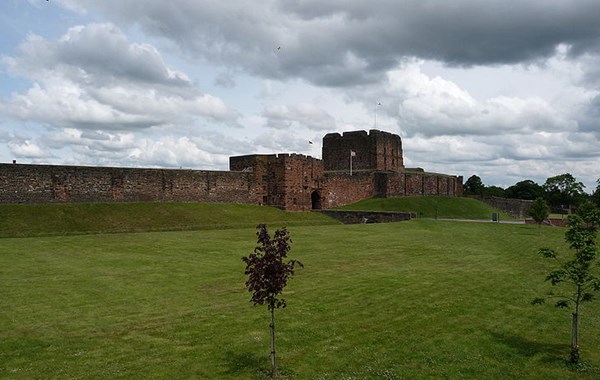
Carlisle Castle stands as one of the most enduring symbols of the long, often turbulent relationship between Scotland and England. Its story is inseparable from the shifting frontier, centuries of conflict, and the lives of many members of the Douglas family who appear repeatedly in its history. What follows brings these strands together into a single narrative suitable for the Douglas Archives.
Foundations on an Older Frontier
Carlisle Castle was first raised during the reign of William II
of England, son of William the Conqueror. Construction began in
1093 on the site of the Roman fort of Luguvalium, dated by dendrochronology to 72 AD. At that time, Cumberland—the old name for north and west Cumbria—was still regarded as part of Scotland. William II’s new Norman motte‑and‑bailey fortification was intended to secure England’s northern border against Scottish incursion.
In 1122, Henry I ordered the timber structure to be rebuilt in stone. The keep and city walls that followed formed the core of the medieval stronghold, with the surviving keep dating from 1122–1135.
On the 24th of May 1153 King David I of Scotland died at Carlisle
Castle. His body was buried in Dunfermline Abbey, Fife, the resting
place of his parents, King Malcolm III and Queen Margaret.
The English seizure of Cumberland provoked repeated Scottish attempts to reclaim the region. For the next 700 years, Carlisle Castle would change hands many times, becoming one of the most fought‑over fortresses on the Anglo‑Scottish frontier.
Early Scottish Assaults
The first major attempt to retake Carlisle came during the troubled reign of King Stephen. Later, on 26 March 1296, John “The Red” Comyn, Lord of Annandale, led a Scottish host across the Solway to attack the city. The castle’s governor was Robert de Brus, the deposed Lord of Annandale and father of the future King Robert the Bruce. Brus successfully repelled Comyn’s assault, forcing the Scots to withdraw through Annandale to Sweetheart Abbey.
This episode is one of many in which the Douglas family would later find themselves entangled.
From the mid-13th century until the Union of the Crowns of England and
Scotland in 1603, Carlisle Castle was the vital headquarters of the
Western March, a buffer zone to protect the western portion of the
Anglo-Scottish border.
Henry VIII converted the castle for artillery, employing the engineer
Stefan von Haschenperg. For a few months in 1567, Mary, Queen of Scots
was imprisoned within the castle, in the Warden's Tower. Later, the
castle was besieged by the Parliamentary forces for eight months in
1644, during the English Civil War.
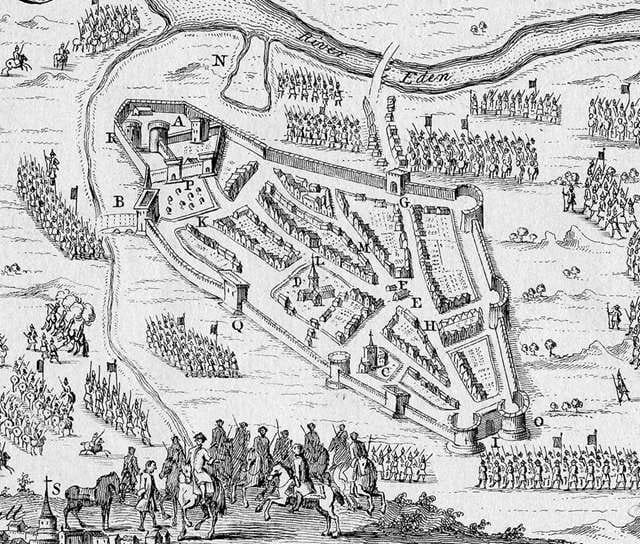
The most important battles for the city of Carlisle and its castle were
during the Jacobite rising of 1745 against George II. The forces of
Prince Charles Edward Stuart travelled south from Scotland into England
reaching as far south as Derby. Carlisle and the castle were seized and
fortified by the Jacobites. However they were driven north by the forces
of William Augustus, Duke of Cumberland, the son of George II. Carlisle
was recaptured, and the Jacobites were jailed and executed. That battle
marked the end of the castle's fighting life, as defending the border
between England and Scotland was not necessary with both countries again
one in Great Britain.
After 1746, the castle became somewhat neglected, although some minor
repairs were undertaken such as that of the drawbridge in 1783.
Douglas Figures in the History of Carlisle
• William Douglas, Lord of Nithsdale (14th century)
In 1385, Sir William Douglas joined the Franco‑Scots army in an assault on Carlisle Castle. The defence was commanded by Lord Clifford. Chroniclers record Douglas performing notable feats of valour and killing many Englishmen, though the siege ultimately failed.
• Sir James Douglas, 7th of Drumlanrig (16th century)
Following the Battle of Solway Moss in 1542, fought close to Carlisle, Sir James Douglas was taken prisoner. His keeper was the Master Customar of Carlisle, a reminder of how deeply the Douglas name was woven into the borderland’s administrative and military life.
• James Douglas, 2nd Earl of Queensberry (17th century)
Initially a supporter of the Scottish National Covenant, Queensberry shifted allegiance to the king in 1645. Attempting to join Montrose after the victory at Kilsyth, he was captured en route and taken prisoner to Carlisle.
• Sir William Douglas of Kelhead (17th century)
Sir William Douglas of Kelhead served as Governor of Carlisle following the siege of 1645. His appointment reflects the trust placed in the Douglas family during a period of intense political and military upheaval.
• Douglas Family of Carlisle (18th century)
Mary, second daughter and co‑heiress of James Douglas, M.D., of Carlisle, represents another branch of the family rooted in the city. James Douglas was the third son of Sir William Douglas, baronet of Kelhead, linking the Carlisle Douglases back to the main Dumfriesshire line.
• Bishop John Douglas (1721–1807)
A scholar, soldier, and churchman, John Douglas served as:
- chaplain at the Battle of Fontenoy (1745),
- Vicar of High Ercall (1750),
- Canon of Windsor (1762),
- Bishop of Carlisle (1787),
- and later Bishop of Salisbury (1791).
His tenure as Bishop of Carlisle places yet another Douglas at the heart of the city’s ecclesiastical and civic life.
Mary Queen of Scots at Carlisle Castle (1568)
One of the most famous episodes in the castle’s history is the brief imprisonment of Mary Queen of Scots. She spent 18 May to 13 July 1568 at Carlisle after fleeing across the Solway Firth following her defeat at Langside.
Mary expected sanctuary from her cousin Elizabeth I, believing she would soon be restored to her throne. Instead, she found herself a royal prisoner.
Conditions of Confinement
Mary was housed in what became known as Queen Mary’s Tower, originally the Norman entrance to the castle. Though now largely ruined (demolished in 1834), it was then one of the best‑maintained parts of the fortress.
Her custodian, Sir Francis Knollys, described her as “pleasant,” but he was under strict orders to prevent any escape. Mary was allowed limited exercise, including walks along the stretch of wall later called
“the Lady’s Walk.”
Her household included her loyal attendant Mary Seton, who helped her maintain her appearance. The cost of supporting Mary and her retinue—£56 per week, paid by Elizabeth I—was considerable.
Despite the relative comfort, Mary was under armed guard, unable to travel or receive visitors without permission. Her short stay at Carlisle foreshadowed the long captivity that would end with her execution nineteen years later.
A Castle at the Heart of Douglas and Border History
From medieval sieges to ecclesiastical appointments, from prisoners of war to royal captives, Carlisle Castle has repeatedly intersected with the story of the Douglas family. Its walls witnessed the ambitions, loyalties, and misfortunes of many Douglases across the centuries.
For the Douglas Archives, Carlisle Castle stands not only as a frontier fortress but as a stage upon which generations of the family played their part in the wider drama of Anglo‑Scottish history.
Comment:
On 13th April in 1596, Kinmont
Willie was rescued from
Carlisle Castle in a daring rescue mission led by the Bold
Buccleuch. Walter Scott, 5th of Buccleuch, 1st Lord Scott
of Buccleuch (1565 – 15 December 1611), known as the "Bold Buccleuch"
was the son of Sir Walter Scott, 4th of Buccleuch (himself grandson of
Walter Scott of Branxholme and Buccleuch) and Margaret Douglas.
See also:
• Douglases in
Carlisle
|