This page is a stub.
You can help improve it.
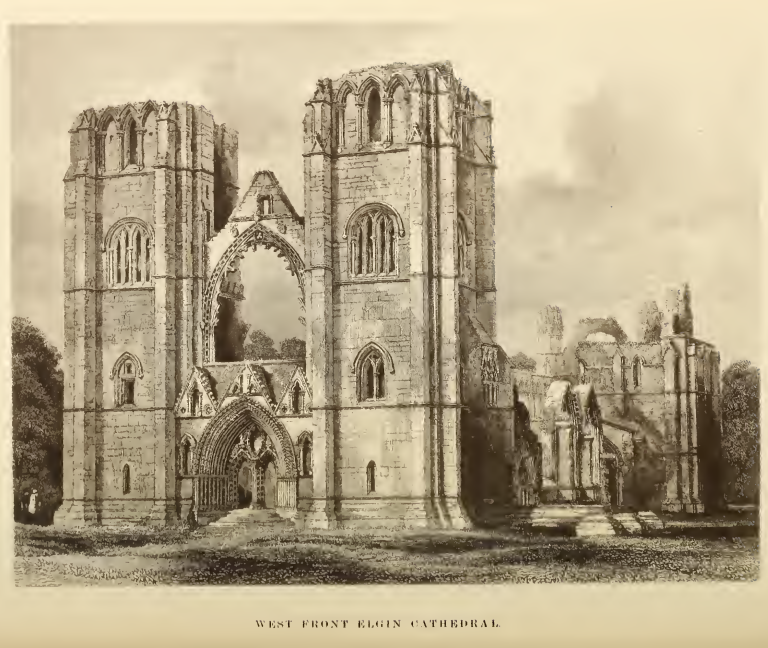
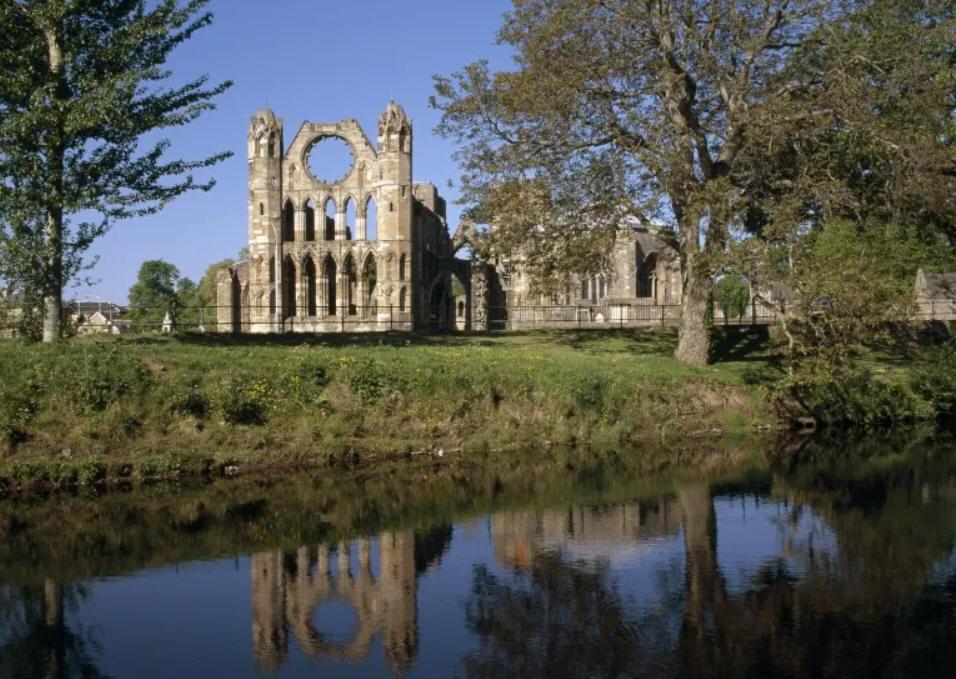
Begun in 1224, Elgin was the principal church of the bishops of Moray. It lost its roof shortly after the Protestant Reformation of 1560, and later its central tower fell. But the cathedral’s fortunes began to change when it became a visitor attraction in the early 1800s.
The “Lantern of the North”
Elgin Cathedral
is one of Scotland’s most magnificent medieval ruins, admired for its
scale, elegance, and the richness of its surviving stonework. Its story
spans grandeur, disaster, and slow decline.
Foundation
and Early Growth (1224–1270)
- The cathedral was formally
founded in 1224, when Bishop Andrew de Moravia secured approval to move
the bishopric from Spynie to Elgin.
-
Dedicated to the Holy Trinity, it quickly became the principal church of
the Bishops of Moray.
- The early structure was already impressive,
but the chapter expanded rapidly—Bishop Andrew issued a new constitution
in 1226 increasing the number of canons.
Fire,
Rebuilding, and Enlargement (1270–1402)
- A major fire in
1270 devastated the cathedral, prompting extensive rebuilding and
enlargement, including a new west doorway.
- Further damage occurred in 1390, when the Wolf
of Badenoch (Alexander Stewart) burned Elgin, including the cathedral.
- Another fire in 1402 led to additional repairs and embellishment.
Reformation and Decline (1560–1711)
- After the Protestant
Reformation of 1560, the cathedral ceased to function as a Catholic
seat.
- Its lead roof was removed, accelerating decay as the
structure was exposed to the elements.
- The central tower collapsed
in 1711, bringing down much of the nave and sealing its fate as a ruin.
A Ruin Preserved
Even as a ruin, Elgin Cathedral remains rich in
detail—carved stone, fragments of stained glass, and architectural
sculpture hint at its former splendour. Today it stands as one of
Scotland’s most evocative medieval monuments.
[Near the above is erected], in the same wall, a marble tablet to the memory of Colin Falconer, who was consecrated Bishop of Moray 1680
Sacred to the memory of Colin Falconer, son of William Falconer of Downduff, and Beatrix Dunbar, who was the daughter of J. Dunbar of Bogs, in the County of Moray, and grandson of Alexander Falconer of Halkerton, and Elizabeth, daughter of
Sir Archibald Douglas of Glenbervie. He was born in the year 1623, and was
married in 1648, to a daughter of Rose of Clava. He was elected to the See of Argyle
1679, and in 1680 he was consecrated Bishop of Moray. He died 11th November,
1686, and was buried in the Aisle of St. Giles' Church of Elgin. This monument was erected by Hugh Innes, Esquire of Lochalsh, M.P. for the County of Ross, anno 1812, his g. g. grandson.
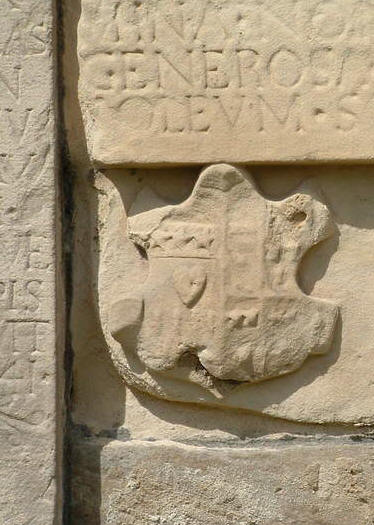
BISHOP DOUGLAS' MONUMENT.
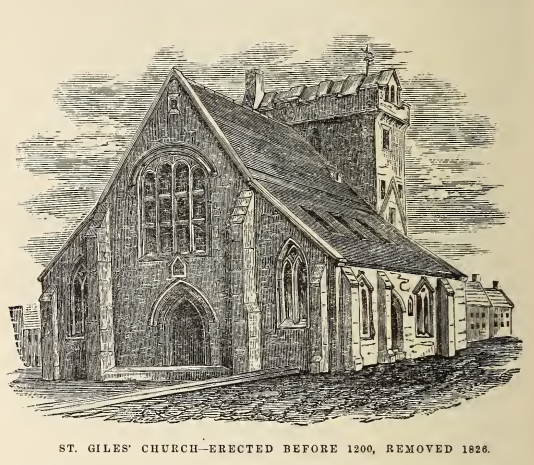
In the spring of 1623, Bishop Alexander Douglas passed away in Elgin, closing a distinguished chapter in the ecclesiastical life of Moray. He was laid to rest in the south aisle of the Church of St. Giles, in a vault lovingly constructed by his widow. In tribute to his memory, she also commissioned a handsome monument within the church—a lasting testament to his service and character.
Over two centuries later, in 1828, the old Church of St. Giles was dismantled. The bishop’s monument, rather than being lost to time, was carefully relocated to Elgin Cathedral, where it now stands embedded in the north enclosing wall. Though the inscription had faded into obscurity by the time Monteith wrote of it in 1704—likely obscured in the dimness of the vault—it is today legible in the open air, though weathering may soon erode its clarity once more.
The Latin epitaph honours Douglas as a vigilant and praiseworthy shepherd to the city and bishop to all Moray, serving faithfully for 41 years. It records his death on 11 May 1623, at the age of 62, and notes that he left behind children—Alexander and Maria—and a pregnant wife, described as both devout and noble. It was she who funded the mausoleum. The inscription closes with a solemn exhortation: “Always watch, for if you do not know when He will come, may He find you prepared,” followed by the scriptural cry: “Death, where is thy sting? Grave, where is thy victory?”
Douglas was likely a member of the Pittendreich branch of the Douglas family. He held lands at Morristown, Spynie, and Burghbriggs, which he conveyed to his wife Mary Innes—daughter of Robert Innes of that Ilk—and to his son Alexander. These estates eventually passed out of Douglas hands: Morristown and Burghbriggs were sold to Robert Martin, a writer in Edinburgh, around 1668, while Spynie was acquired by James Brodie of Whitehill, forebear of the present Brodie of Brodie, near the end of the seventeenth century.
Burials at Elgin Cathedral
jessie_douglas+others.jpg)
With thanks to Margaret Nancy Whyte
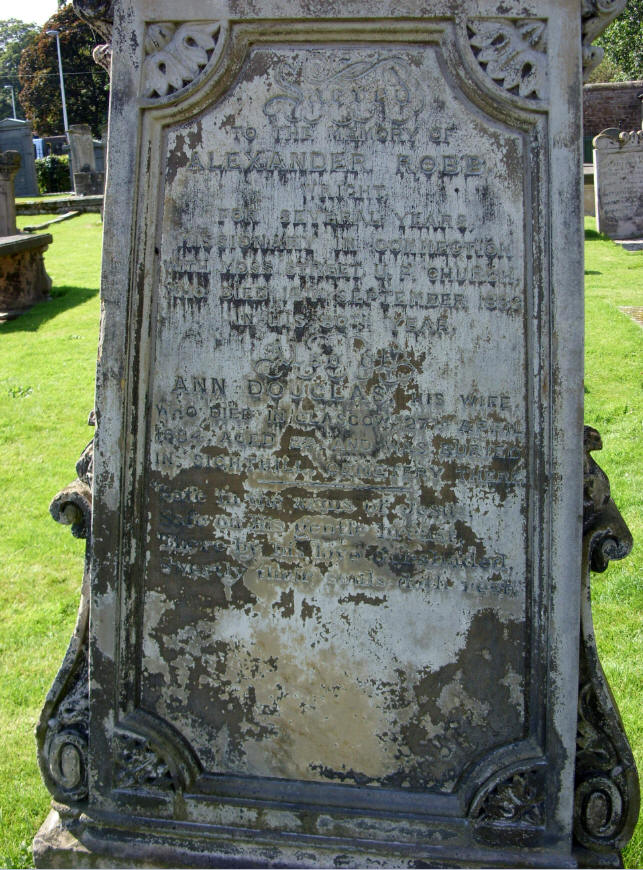
a. TO THE MEMORY OF ALEXANDER ROBB WRIGHT FOR SEVERAL YEARS MISSIONARY IN CONNECTION WITH MOSS STREET U.P. CHURCH WHO DIED 14TH SEPTEMBER 1883 IN HIS 80TH YEAR.
ALSO OF ANN DOUGLAS HIS WIFE WHO DIED IN GLASGOW 27TH APRIL 1884 AGED 82 AND WAS BURIED IN SIGHTHILL CEMETERY THERE.
"Safe in the arms of Jesus, Safe on His gentle breast, There by His love o’ershaded, Sweetly their souls doth rest."
Comment: Alexander Robb served as an Elder and a Missionary for
the Moss Street United Presbyterian (U.P.) Church in Elgin. The church
mentioned on the stone, Moss Street United Presbyterian Church, was a
significant congregation in Elgin. It later became part of the United
Free Church (U.F.) after a series of denominational mergers in Scottish
church history.
b. ERECTED BY JESSIE DOUGLAS IN MEMORY OF HER BROTHER WILLIAM DOUGLAS SON OF JAMES DOUGLAS CARRIER ELGIN WHO DIED 24TH FEBY 1855 AGED 23 YEARS. ALSO OF THE SAID JESSIE DOUGLAS WHO DIED 27TH JANY 1902 AGED 83 YEARS.
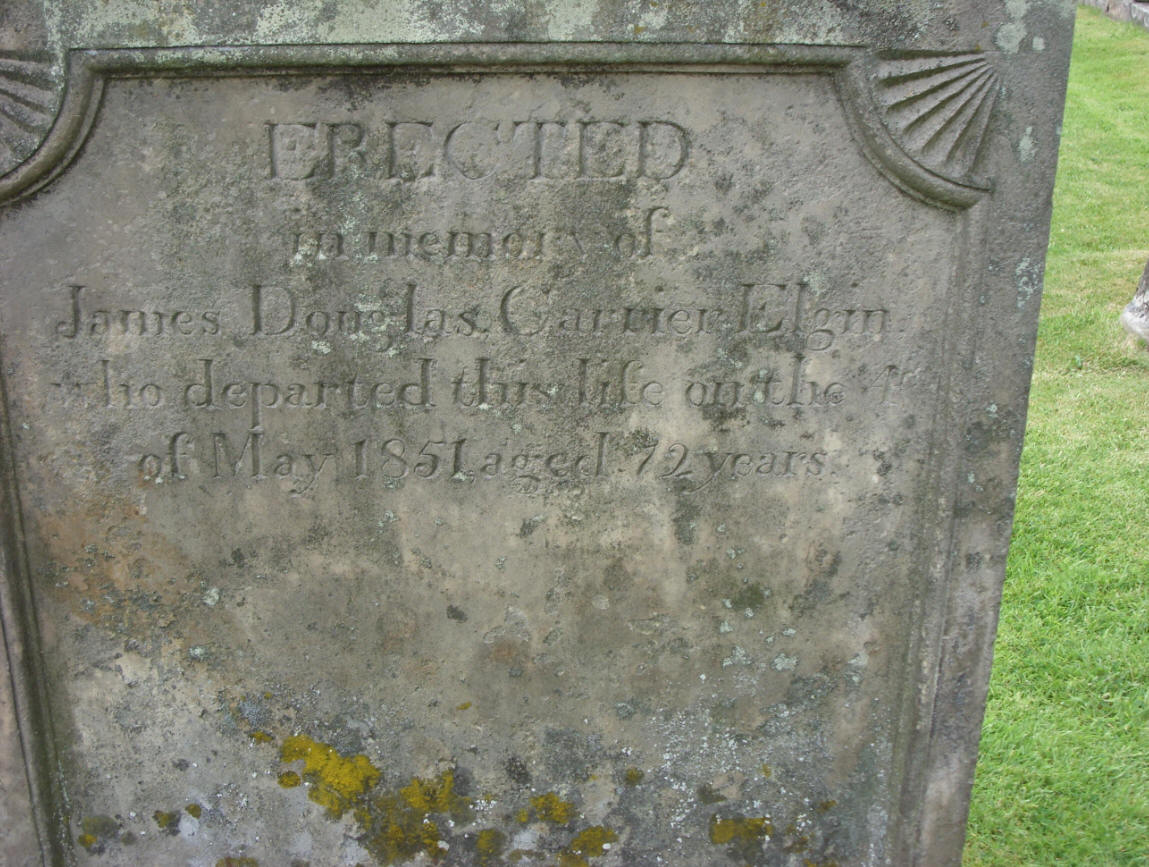
c. ERECTED in memory of James Douglas, Carrier Elgin who departed this life on the [4th] of May 1851 aged 72 years.
Comment: Based on the inscriptions, we can piece together the following family group:
James Douglas: (The father) A carrier in Elgin who died in May 1851 at age 72.
William Douglas: (The son) Died in February 1855 at age 23, meaning he was born around 1832.
Jessie Douglas: (The daughter) Lived a long life, passing away in January 1902 at age 83, meaning she was born around 1819.
Contributions
Do you have an ancestor whose
story should be told here? Can you add to this article? Please let us have the details.
|