|
| |
Genealogical information, relating to the families of the noble
lords, Counts Scotti Douglas of Vigoleno, Sarmato, and Fombio – Luigi
Naldi – Piacenzar
|
|
|
This page is a stub.
You can help improve it.
(GENEALOGICAL INFORMATION, RELATING TO THE FAMILIES OF THE NOBLE LORDS,
COUNTS SCOTTI DOUGLAS OF VIGOLENO, SARMATO, AND FOMBIO – LUIGI NALDI –
PIACENZA 22 MAY 1858)
The first known member of this family was
Lanfranco, son of Davide, who was a representative of the Municipality
of Piacenza. Lanfranco had four sons: Giovanni, Ruffino, Rolando, and
Rinaldo, from whom all the branches of the family descended: Vigoleno,
Sarmato and Fombio, Castelbosco and Mamago, Passano, Varsi, and Gravago.
The Scotti family belonged to the Guelph party and were the party's
leaders in the Piacenza area. They created a society that brought
together Piacenza's nobles: the Societas Scotorum, which engaged in both
commercial and banking activities, operating in Genoa and abroad.
The
significant profits they made allowed them to make numerous investments,
creating a considerable landed estate that remained virtually unchanged
until the late 19th and early 20th centuries.
Giovanni, Lanfranco's
eldest son, founded the Scotti lineage of Vigoleno,
Sarmato, and
Fombio.
Giovanni's son, Alberto, was elected Captain of the People and Lord of
Piacenza in 1290. Alberto nurtured the desire to create his own
lordship; in 1302 he defeated Matteo Visconti, taking him prisoner, and
extended his dominion to Milan and Bergamo. He was briefly Lord of
Milan, but despite his membership in the Guelph party, he was abandoned
by his allies and forced to abandon Milan to the Viscontis. He lost
power and regained it in fits and starts until his final defeat in 1317
at the hands of Galeazzo Visconti.
This defeat definitively and
definitively ended the possibility of creating a lordship led by
Piacenza.
Alberto Scotti, who began work on the great town hall of
Piacenza known as the Gothic Palace, had four sons: Francesco I, from
whom descended the Counts of Vigoleno, the Counts of Sarmato, and the
Counts of Agazzano; Pietro, Giacomo, and Nicolò, from whom descended the
Scotti of Vicomarino, Castel San Giovanni, and Fombio.
Giovanni and
Francesco I, sons of Alberto II and Cristoforo, grandsons of Francesco
I, were awarded the title of Count of Agazzano by Giovanni Maria
Visconti in 1404, and the title of Count of Vigoleno by Giovanni Maria
Visconti. They also obtained the fiefdom of Castell'Arquato in 1407.
The Scotti di Sarmato family's rule was turbulent and contested by the
Arcelli Fontana family. Alberto Scotti was imprisoned in the Rocca
d'Olgiso in 1410.
Alberto was freed thanks to the payment of a ransom
in 1414, and together with his brother Pietro, he received from Emperor
Sigismund of Luxembourg, with an Imperial Bull dated February 12, 1414,
the title of Count of Castell'Arquato, Fiorenzuola, Vigoleno, and other
places (as evidenced by a notarial deed dated August 22, 1421, by Notary
Bartolomeo da Caverzago). They were also awarded the title of Douglas.
Alberto regained possession of Sarmato only in 1441, when the power of
the Arcelli family waned. He later also obtained the investiture of the
fiefdoms of Carpaneto, Chero, and Fontana Fredda from the Dukes of
Milan. Pietro died young, and in 1423 his mother had his bones, which
were buried in the parish church of Vigoleno in San Giovanni in Canale
in Piacenza, transferred.
Count Bartolomeo Scotti Douglas, son of
Albert II, was advisor to Francesco and Galeazzo Maria, Dukes of Milan.
He enjoyed great renown among the citizens. He contributed significantly
to the redevelopment of the city of Piacenza by financing the repair of
the city walls, which were falling into disrepair. On October 8, 1479,
Gian Galeazzo Maria Sforza, Duke of Milan, granted him permission to
complete and restore the castle of Diolo to better defend himself from
the violence and harassment of the men of Rustigazzo. On August 1, 1478,
he again received Galeazzo Maria Sforza Visconti's consent to fortify
and restore the castles of Gragnano and Agazzano. Bartolomeo Scotti
Douglas married Countess Eleonora Rossi di San Secondo, with whom he had
three children: Francesco Maria, Giovanni Maria, Antonio Maria, Ippolita,
and Antonia.
The Scotti Douglas branch of Vigoleno also gave birth to
Count Pietro Maria, known as Busio, son of Francesco Maria and
Marchioness Francesca Pallavicini. He distinguished himself by waging
war against the city of Piacenza to overthrow the Guelph party to which
he had belonged, but from which he deserted and became a Ghibelline. He
participated in several raids throughout the Piacenza area, from
Ferriere to Agazzano, where he was murdered in September 1521. Pietro
Maria married Countess Camilla Scotti Douglas of Fombio, daughter of
Hector I, and they bore him Galeazzo, nicknamed Busino because he acted
like his father in life and was murdered like him.
Meanwhile, around
1540, Count Alessandro Maria Scotti Douglas, son of Guglielmo, who in
turn was also the son of Francesco Maria and Marchesa Francesca
Pallavicini, had the family Oratory in the fountain square in Vigoleno
restored and embellished. The Oratory had been built in 1389 by Count
Francesco Scotti, son of Cristoforo, when the Duke of Milan Giovanni
Angelo Maria Visconti granted him the right to rebuild the Castle of
Vigoleno.
The Scotti family of Vigoleno also included a Marquis in
the person of Cesare Maria Scotti Douglas, son of Alessandro Maria and
Countess Eleonora Confalonieri. His first marriage was to Countess
Angela Anguissola, daughter of Count Roberto di Monte Santo, and his
second marriage to Marchioness Vittoria Landriana Della-Rovere. Cesare
Maria was one of the most beloved Knights at the Court of Duke Ranuzio
Farnese, who, with a royal diploma, created him Marquis of Vigoleno,
Diolo, Carpaneto, and its Jurisdictions. Marquis Cesare Maria Scotti
Douglas was Duke Ranuzio I's Ambassador to the Courts of Rome, Spain,
and Turin, as well as to the most powerful Italian and foreign Princes.
He died in Milan on October 12, 1622, and his remains rest in San
Giovanni in Canale in Piacenza.
The Marquises' history was enriched
by Cesare Maria's son, Marquis Odoardo Scotti Douglas, who was Grand
Squire and Grand Horseman to H.H. Duke Ranuzio II and Ambassador to
Germany on the occasion of the marriage of Dorothea Sophia of Nevburg to
Prince Odoardo Farnese. Odoardo's son, Marquis Filippo Scotti Douglas,
who married Countess Anna Boschetti of Modena, was also a Knight and
received a classical and scientific education. He was declared a Major
Cavallerizzo by Duke Francesco Farnese with a patent dated August 30,
1693, and incorporated into the Modenese Citizenship with a diploma from
Rinaldo, Duke of Modena, on March 30, 1731. It was Marquis Filippo
Scotti Douglas who built the Palazzo degli Scotti di Vigoleno in
Piacenza, near San Giovanni in Canale, from the ground up, laying the
first stone on June 20, 1718. This palace was built on the ruins of the
one inhabited by his great ancestor Alberto, which was devastated in
1309 by the then-dominant factions. The building was carried out by
master builder Ignazio Cerri. Marquis Filippo Scotti Douglas degli
Scotti di Vigoleno died on July 2, 1732, and was buried in the family
tomb in San Giovanni in Canale in Piacenza.
Marquis Filippo and
Countess Anna Maria Boschetti fathered several children, including the
eldest son to inherit the title of Marquis, Francesco Scotti Douglas,
who married Marchioness Lucrezia Pallavicini of Parma.
Count Gaetano
Maria Scotti Douglas, son of Marquis Filippo and Marchioness Teresa
Tebaldi, married Countess Calciati, daughter of Count Giuseppe. Marquis
Filippo Scotti Douglas, son of Marquis Alberto and Marchioness Francesca
Recalcati, was likely the grandson of Marquis Francesco Scotti Douglas.
Count Gaetano Maria Scotti Douglas spent a great deal of time in
Vigoleno and is remembered for having had the Pona road, which connected
Vigoleno to the small municipality of Vernasca, improved and made
perfectly passable in 1850, thus providing better access to all the
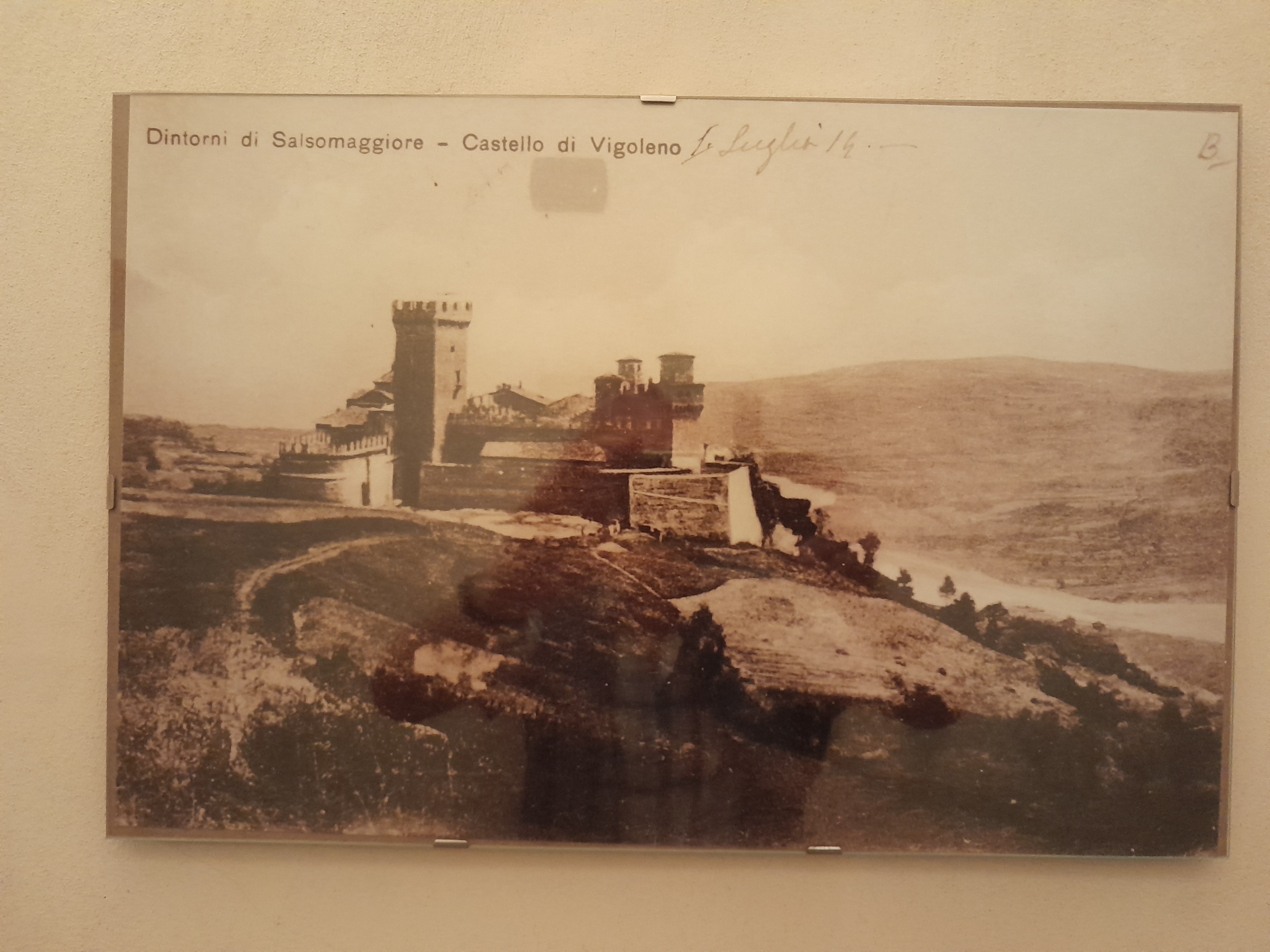
surrounding villages. In the same year, he also had Vigoleno Castle
redecorated and restored.
Naturally, the Scotti family of Vigoleno
was much larger; the aim of this article is simply to highlight how this
family played an important role not only within the limited territorial
area of Vigoleno but also within the Duchy and, through it, throughout
Europe, in the various countries that some of its members visited as
ambassadors.
Over the centuries, this family has divided into various
branches, including the Piedmontese and the Neapolitan; it has lived in
Vigoleno, Sarmato, Gravago, Varsi, Passano, Mamago, Casa del Bosco,
Fombio, Vico-Marino, Agazzano, Cremona, Parma, and one branch has even
moved to Spain.
“To these ancient names, we will add others recorded
in the histories and conspicuous, for military services rendered even
outside the homeland and others no less illustrious for civil wisdom, if
the matter were not too long, requiring special consultations. We could
say of Nicolò (1514) a valiant and prudent leader of the Venetian armies
in the wars against the Dukes of Milan, praised for military sciences by
the Doge Loredano in the name of that republic; of Ranuzio (1690),
awarded very important diplomatic roles, a shrewd politician, a person
of great authority also in other Italian courts. And of Orazio Scotti in
particular we would say, companion in the enterprises of Flanders and
Navarino of Alessandro Farnese, who remembered him honorably in his
testamentary tables. Let it be enough for us, however, to indicate those
names and close these brief biographical notes with Giulio Clemente
Scotti, who raised his fame high in the early seventeenth century. At
that time in in which Italian universities vied to appoint the most
celebrated men to the chairs, especially of Philosophy and Theology;
Scotto banished those sciences first from those of Parma, then Ferrara,
and finally Bologna. He saw that gloomy and fallacious Scholasticism
confined minds to a very narrow sphere, that it retarded the useful
knowledge of truth, and created a Philosophy of words that was
insidious, arid, and combative, a Theology more redundant with
subtleties than with solidity. Far from these principles, he attempted
with tireless locutions to make his doctrines prevail, and he defended
them in print, so much so that he made it impossible for him to enter
the Society of Jesus, to which he had belonged in his youth. Upon
leaving, in fact, he vented his anger against it and especially against
Cardinal Sforza Pallavicini, his rival, whom he had attacked too
venomously in various works that he published. Venice welcomed him while
the storm raged more than ever over him. and, recognizing his genius,
did not hesitate to elect him professor of canon law at the University
of Padua, which was still flourishing at the time.
It is worth noting
that the various branches of the Scotti family, which are distinguished
in the genealogical trees, are validated by attestations drawn from
documents either preserved in the archives of this family (which are
numerous and of indisputable authenticity) or from original notarial
deeds found in the public archives; that these attestations are
supported by authentications; finally, that the genealogies expressed
above refer only to the descendants of Alberto I, called Riccio,
distinct, as we have said, from the Scotti Douglas of Vigoleno, Sarmato,
and Fombio”
Contributions
Do you have an ancestor whose
story should be told here? Please let us have the details.
|
Source
Sources for this article include:
Il borgo di Vigoleno e la famiglia Scotti
- where links to further reading can be found
Any contributions will be
gratefully accepted
|
|