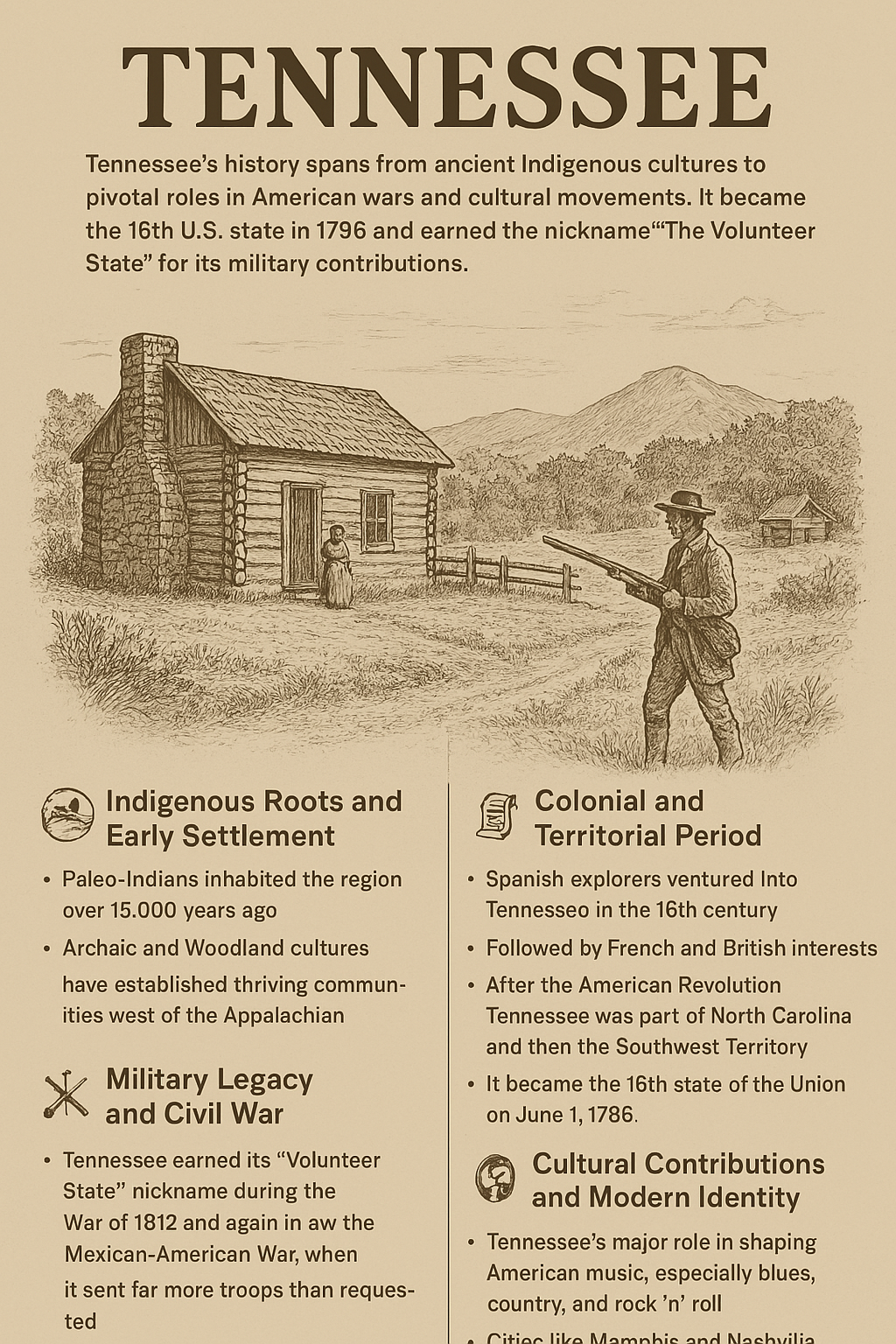
Tennessee: A Tapestry of Time and Tenacity
From the retreat of the last Ice Age glaciers to the rise of musical legends, the land we now call Tennessee has long been a crossroads of cultures, ambitions, and identities. Its story is one of ancient roots, frontier resilience, and the enduring legacy of families like the Douglases, who helped shape its earliest institutions.
Ancient Foundations: The First Peoples
Long before state lines or settler cabins, Tennessee was home to the Paleo-Indians, nomadic hunters who followed mastodons and caribou into the region some 12,000 to 15,000 years ago. As the climate warmed, their descendants—known as the Archaic peoples—settled along river terraces, gathering nuts and berries, fishing, and slowly turning to agriculture.
By 1000 BC, the Woodland cultures had emerged, building burial mounds and crafting pottery. Their legacy was eclipsed by the rise of the Mississippian culture (900–1600 AD), whose temple mounds and maize-based economies supported powerful chiefdoms along the Tennessee, Cumberland, and Mississippi Rivers.
When Europeans arrived, they encountered a land claimed by the Cherokee in the east, the Chickasaw in the west, and the Shawnee in the central valleys—each with deep ties to the land and its stories.
First Contact and Colonial Rivalries
The first European to set foot in Tennessee was likely Hernando de Soto in 1540, whose expedition left devastation in its wake. Disease and disruption followed, unraveling Indigenous societies long before permanent European settlements took hold.
By the late 1600s, both French and British explorers were vying for influence. French missionaries and traders moved down the Mississippi, while English agents crossed the Appalachians to trade with the Cherokee. The 18th century became a chessboard of imperial ambition, with Native nations caught in the middle.
The Frontier Awakens
Despite British attempts to halt westward expansion with the Proclamation of 1763, restless pioneers from Virginia and North Carolina pressed into the Tennessee Valley. Among them were the “long hunters”—men like Kasper Mansker and Daniel Boone—who blazed trails through the Cumberland Gap, opening the land to settlement.
In 1769, settlers began arriving in the Watauga Valley, forming the Watauga Association in 1772—an early experiment in frontier self-government. Among these settlers were Naomi Douglas and her husband Valentine Sevier Jr., who moved to Sycamore Shoals around 1771–72. Their participation in the Watauga Association placed the Douglas family at the heart of Tennessee’s earliest civic institutions.
Revolution and the Road to Statehood
During the American Revolution, Tennessee’s settlers became the Overmountain Men, whose victory at Kings Mountain in 1780 helped turn the tide in the South. After the war, the region briefly declared itself the State of Franklin (1784–88), a bold but short-lived bid for independence.
By 1790, the area was organized as the Southwest Territory, and in 1796, Tennessee entered the Union as the 16th state, its name drawn from the ancient Cherokee town of *Tanasi*.
The Douglas Legacy in Middle Tennessee
As the eastern settlements matured, a second wave of Douglas pioneers helped shape the Cumberland frontier. Around 1785–86, Colonel Edward Douglass Sr. and his seven sons settled along Station Camp Creek in what is now Sumner County. He became one of the county’s first magistrates, hosting early court sessions in his home.
His sons carried the torch into statehood. In 1796, Edward Douglass Jr. and James Douglass were appointed among the first Justices of the Peace by Governor John Sevier, with Edward Jr. later serving as a State Senator. Their leadership helped anchor Tennessee’s new government in the rule of law and civic service.
The Volunteer Spirit and Civil War Trials
Tennessee earned its enduring nickname—“The Volunteer State”—during the War of 1812 and the Mexican–American War, when it sent more troops than any other state. But the Civil War brought bitter division: Tennessee was the last to secede from the Union in 1861 and the first to be readmitted after the war. Its hills and rivers bore witness to some of the war’s fiercest battles and deepest scars.
Culture, Resilience, and Modern Identity
Out of hardship came harmony. Tennessee became a cradle of American music: blues from Memphis, country from Nashville, and rock ’n’ roll from the crossroads in between. Its Appalachian traditions, African American spirituals, and Scots-Irish ballads fused into a soundtrack that echoed far beyond its borders.
Today, Tennessee’s story is one of resilience and reinvention. From ancient mounds to modern music halls, from the Watauga Association to the halls of state government, it remains a land where history is not just remembered—it’s lived.
See also:
• The Douglas
family in Tennessee
Contributions
Do you have an ancestor whose
story should be told here? Can you add to this article? Please let us have the details.
|